
Alibaba has released Qwen3.8, an open-weight update featuring a 27 billion parameter dense vision-language model and a massive 2.4 trillion parameter mixture-of-experts system that activates 95 billion parameters during inference. The new architecture interleaves fast linear layers with full self-attention blocks to balance speed and complex reasoning, while configurable thinking controls let developers dial in cost versus quality across long-horizon agentic workflows. Benchmark results show the 27B model edges out Opus 4.6 Max on LiveCodeBench and instruction following, and the larger MoE variant trails only Fable 5 and GPT-5.6 Sol on the hardest coding tasks. Both models now sit on HuggingFace with 17 quantized variants available, bringing frontier-tier capability directly to consumer hardware and datacenter deployments.
Alibaba Open-Sources Qwen3.8, Unleashing a 2.4 Trillion Parameter “Qwen-Max” Model and a Compact Vision-Language System
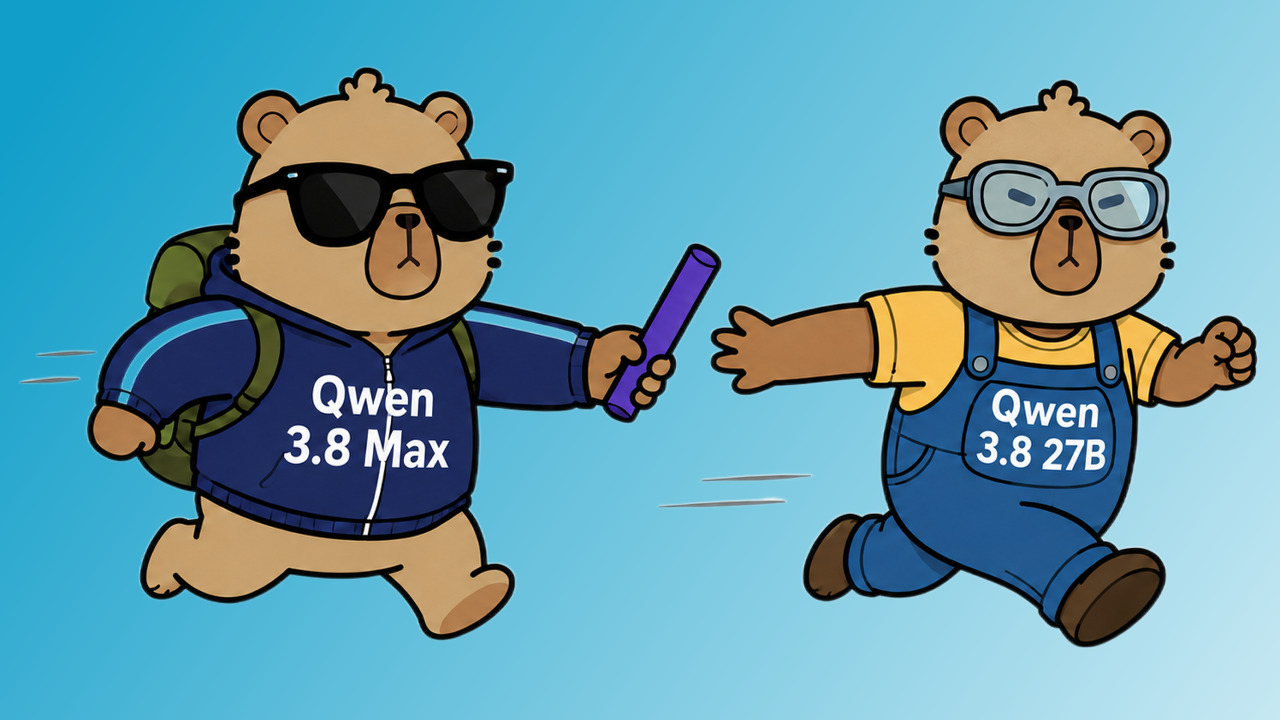
Alibaba’s Qwen team has officially released Qwen3.8, a new generation of open-weight models that includes what the company is calling its first “Qwen-Max-class” open release. The update drops two systems built on a refreshed architecture: a 27 billion parameter dense vision-language model and a 2.4 trillion parameter mixture-of-experts model that only activates 95 billion parameters during inference.
This marks a meaningful shift in how Alibaba positions its frontier research. Up until now, Max-tier capability lived exclusively behind their commercial API. Now it’s sitting on HuggingFace under a custom license, while the smaller dense model carries the standard Apache 2.0 tag. Keep in mind that this isn’t a simple weight swap. Both models run on a hybrid attention design that interleaves fast linear layers with full self-attention blocks. Six months ago, Alibaba was still shipping incremental Qwen3.5 updates, and they are now pushing a 2.4 trillion parameter system to open weights. That kind of cadence signals genuine ambition.
Architecture and Reasoning Control
The hybrid layout splits into three Gated DeltaNet layers followed by one full attention layer, repeated across the network. The 27B variant stacks 64 transformer layers with a hidden dimension of 5120. The massive 2.4T-A95B model pushes that to 92 layers and an 8192 hidden dimension. Both use a vocabulary size of 248,320 and are trained with Multi-Token Prediction to look several steps ahead during decoding.
DeltaNet handles the heavy lifting for long sequences, while the gated attention layer kicks in when the model needs to reason through something non-trivial. It’s a deliberate tradeoff. You get most of the speed benefits of linear attention without completely losing the ability to hold complex context in memory. The 2.4T model (routes through 512 experts per token, but only activates 10 of them plus a shared expert, keeping effective compute steady around 95B. That keeps the memory footprint manageable even if the raw parameter count reads like a datacenter’s budget plan.
Both models also ship with configurable reasoning depth out of the box. You’ll see a reasoning_effort setting that flips between low, medium, and high, along with thinking output wrapped in standard tags by default. If you want to skip the internal deliberation for straightforward prompts, the 27B model supports enable_thinking=False. The large MoE variant always thinks, which tracks with its intended use case. What’s actually novel here is that historical reasoning traces persist across conversation turns. That solves a quiet frustration many developers have run into when building agentic workflows. The model stops forgetting how it originally approached a problem just because you added a third follow-up. Not cheap to run at high effort, but you get the quality to match.
The Numbers and Deployment
The 27B model punches well above its weight class. On SWE-bench Pro, it lands 61.7 compared to 53.5 for the previous Qwen3.6 generation and 53.4 for what was previously a proprietary benchmark wall. LiveCodeBench v6 sits at 90.3, which actually edges out Opus 4.6 Max at 88.8. Instruction following on IFBench hits 79.5 against 62.5 for the same baseline. For a single dense model, that’s arguably competing with hardware budgets triple its size.
The 2.4T-A95B model trades blows with Fable 5 and GPT-5.6 Sol on most fronts but comes also with a remarkable size of 4.89 TB of data. It pulls a 67.7 on SWE-bench Pro and 56.6 on DeepSWE 1.1. PaperBench hits 93.0, which is the highest reported score across every benchmark tested. It trails on the hardest coding tasks, but the gap is narrow. For the 27B model specifically, image and video understanding isn’t an afterthought. It clocks 84.3 on OSWorld computer use and 64.8 on WebArena browser tasks. AndroidWorld comes in at 81.9. You can feed it hour-long videos with configurable frame sampling, and it handles hybrid-agent workflows across desktop, mobile, and web environments without choking. The 2.4T model skips vision entirely, focusing purely on text and code.
vLLM, SGLang, and TokenSpeed all support inference out of the gate. The community has already shipped 17 quantized variants for each model across llama.cpp, Ollama, LM Studio, and Jan. If you want to run the 27B dense model on a consumer machine, those quantizations preserve most of the performance while trimming the RAM demand. The MoE variant weighs in at roughly 4.8 terabytes in BF16, so you’ll still need serious hardware for the unquantized weights. The managed API on Qwen Cloud ships with the full 1M context window and built-in tooling, which cuts down on deployment friction.
It’s a rather aggressive push from Alibaba. They’re betting that hybrid attention and controlled reasoning will matter more to developers than raw parameter count alone. The architecture is unorthodox, and the benchmark gaps on the hardest coding tasks suggest it still has room to grow. However, at the same time, giving teams fine-grained control over thinking depth and persisting that context across turns is exactly the kind of developer experience that turns experimental models into production pipelines.
Head here to grab the weights for Qwen3.8 27B, here for Qwen3.8 2.4T A95B, or check the official blog post for the full benchmark breakdown and deployment guides.
