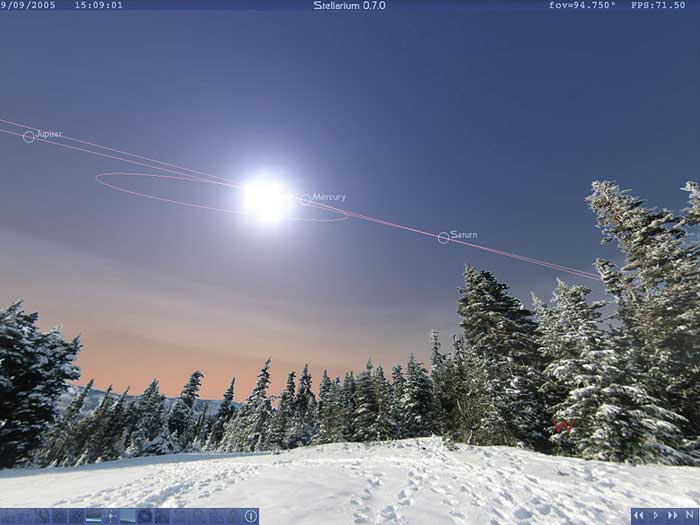
Stellarium 26.3 has been released, continuing its legacy as a free and open-source planetarium software that provides users with a realistic 3D representation of the night sky. The software is designed for use on computers and is also available in a portable version, making it accessible for various platforms. Stellarium allows users to observe celestial objects as they would appear to the naked eye, through binoculars, or via a telescope, making it an excellent tool for both amateur astronomers and educational settings, including planetarium projectors.
Key Features of Stellarium:
- Sky Visualization: The software includes a default catalog of over 600,000 stars, with access to additional catalogs containing more than 210 million stars. It features detailed illustrations of constellations, images of nebulae from the full Messier catalog, and a realistic depiction of the Milky Way, complete with atmospheric effects for sunrise and sunset. Users can also view planets and their satellites.
- User Interface: Stellarium boasts a powerful zoom feature and time control functionality. It supports multiple languages and includes scripting capabilities for users to record and replicate their own shows. The software is equipped with fish-eye and spherical mirror projection options for use in planetarium domes, along with a flexible graphical interface and comprehensive keyboard controls. Telescope control is also integrated.
- Visualization Tools: Users can benefit from equatorial and azimuthal grids, star twinkling effects, shooting star simulations, and eclipse simulations. The software allows for skinnable landscapes with support for spherical panorama projections.
- Customizability: Stellarium is highly customizable, enabling users to add their own deep-sky objects, unique landscapes, constellation images, and scripts to enhance their experience.
Extension:
With the latest release of Stellarium 26.3, users can expect ongoing improvements and possibly new features that further enhance the realism and interactivity of the software. The development team may introduce more extensive catalogs, improved simulation capabilities, and additional customization options to cater to the evolving needs of its user base. Furthermore, educational institutions could leverage Stellarium for interactive learning experiences in astronomy, helping to foster a deeper understanding of celestial phenomena among students. As technology advances, Stellarium may also integrate augmented reality features, allowing users to connect their experiences with real-time data from telescopes or observatories, thus bridging the gap between virtual exploration and actual astronomical observation
Key Features of Stellarium:
- Sky Visualization: The software includes a default catalog of over 600,000 stars, with access to additional catalogs containing more than 210 million stars. It features detailed illustrations of constellations, images of nebulae from the full Messier catalog, and a realistic depiction of the Milky Way, complete with atmospheric effects for sunrise and sunset. Users can also view planets and their satellites.
- User Interface: Stellarium boasts a powerful zoom feature and time control functionality. It supports multiple languages and includes scripting capabilities for users to record and replicate their own shows. The software is equipped with fish-eye and spherical mirror projection options for use in planetarium domes, along with a flexible graphical interface and comprehensive keyboard controls. Telescope control is also integrated.
- Visualization Tools: Users can benefit from equatorial and azimuthal grids, star twinkling effects, shooting star simulations, and eclipse simulations. The software allows for skinnable landscapes with support for spherical panorama projections.
- Customizability: Stellarium is highly customizable, enabling users to add their own deep-sky objects, unique landscapes, constellation images, and scripts to enhance their experience.
Extension:
With the latest release of Stellarium 26.3, users can expect ongoing improvements and possibly new features that further enhance the realism and interactivity of the software. The development team may introduce more extensive catalogs, improved simulation capabilities, and additional customization options to cater to the evolving needs of its user base. Furthermore, educational institutions could leverage Stellarium for interactive learning experiences in astronomy, helping to foster a deeper understanding of celestial phenomena among students. As technology advances, Stellarium may also integrate augmented reality features, allowing users to connect their experiences with real-time data from telescopes or observatories, thus bridging the gap between virtual exploration and actual astronomical observation
Stellarium 26.3 released
Stellarium is a free, Open Source planetarium for your computer that shows a realistic sky in stunning 3D. Also available as a Portable version.