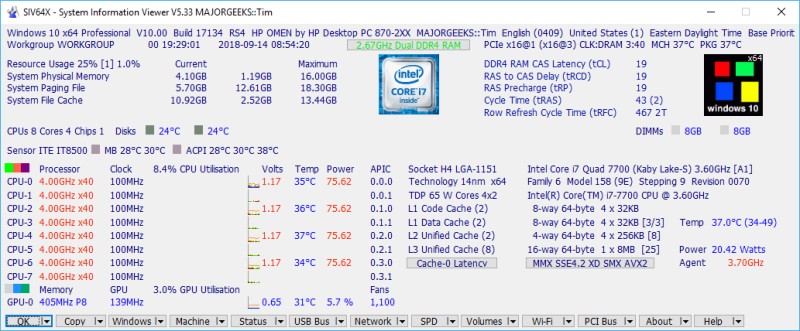
SIV (System Information Viewer) has been updated to version 5.87, a versatile tool designed for displaying essential information related to Windows systems, network configurations, and hardware components. It provides detailed insights into various system elements including the CPU, PCI, PCMCIA, USB, SMBus, SPD, and ACPI, making it an invaluable resource for users seeking to understand their system's architecture and performance.
Compatible with a wide range of Windows versions, including Windows 11, 10, 8.1, 8.0, 7, Vista, XP, and several server editions (from 2000 to 2022), SIV is a comprehensive utility that serves both general users and IT professionals alike. Additionally, the software has capabilities that allow users to control All-In-One (AIO) devices such as fans and LED lights. Users can activate this feature by using the -AIOCTL command line qualifier, which initiates necessary changes to the Enhanced Power Management settings and restarts the USB device.
SIV utilizes several text files to gather device descriptions: pcidevs.txt for PCI devices, usbdevs.txt for USB devices, and mondevs.txt for monitoring PCMIA devices through pcmdevs.txt. This structured approach enables the software to present accurate and detailed information effectively.
In conclusion, SIV 5.87 is a powerful tool for anyone looking to delve deeper into their system's specifications and performance metrics. It not only supports a broad range of Windows operating systems but also provides functionalities that enhance user control over hardware components. For additional resources, users can explore guides on identifying hardware, motherboard details, CPU cores, and Intel processor generations, thereby maximizing the utility of SIV in system management and troubleshooting
Compatible with a wide range of Windows versions, including Windows 11, 10, 8.1, 8.0, 7, Vista, XP, and several server editions (from 2000 to 2022), SIV is a comprehensive utility that serves both general users and IT professionals alike. Additionally, the software has capabilities that allow users to control All-In-One (AIO) devices such as fans and LED lights. Users can activate this feature by using the -AIOCTL command line qualifier, which initiates necessary changes to the Enhanced Power Management settings and restarts the USB device.
SIV utilizes several text files to gather device descriptions: pcidevs.txt for PCI devices, usbdevs.txt for USB devices, and mondevs.txt for monitoring PCMIA devices through pcmdevs.txt. This structured approach enables the software to present accurate and detailed information effectively.
In conclusion, SIV 5.87 is a powerful tool for anyone looking to delve deeper into their system's specifications and performance metrics. It not only supports a broad range of Windows operating systems but also provides functionalities that enhance user control over hardware components. For additional resources, users can explore guides on identifying hardware, motherboard details, CPU cores, and Intel processor generations, thereby maximizing the utility of SIV in system management and troubleshooting
SIV (System Information Viewer) 5.87 released
SIV (System Information Viewer) displays useful Windows, network, and hardware info.