
Moonshot AI has released Kimi K3, a 2.8 trillion parameter Mixture-of-Experts model that challenges Claude Fable 5 and GPT-5.6 Sol with frontier-level agentic performance. The open-weight release is available on Hugging Face, bringing efficient inference and a 1 million token context window to researchers and enterprises.
Moonshot AI Releases Kimi K3: The First Open-Weight 2.8-Trillion-Parameter Frontier Model
Moonshot AI dropped the weights for Kimi K3 on Hugging Face today. July 27, 2026. The model clocks in at 2.8 trillion parameters, making it the first open-weight model to reach the 3T class, though active parameter count tells a different story for inference.
Hacker News lit up immediately. The official blog post climbed past 2,100 upvotes with over 1,200 comments within hours. The traffic spike forced Moonshot to suspend new subscriptions temporarily as demand overwhelmed the API.
Kimi K3 is positioned as a direct challenger to Anthropic's Claude Fable 5 and OpenAI's GPT-5.6 Sol. Moonshot claims it's the first open model to reach parity with top proprietary models in agentic knowledge work. The community is treating it as a watershed moment for open-weight intelligence.
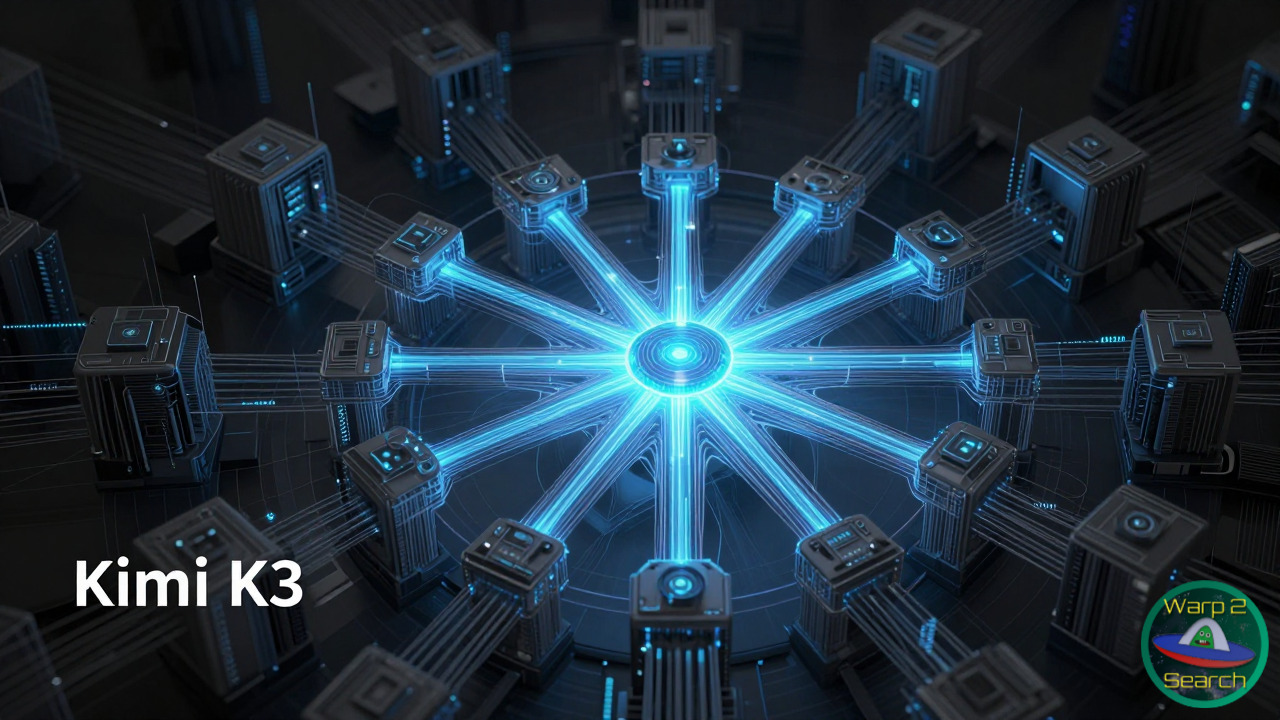
Spec Sheet and Architecture
It's a rather large model by any metric, though the Mixture-of-Experts design keeps inference feasible. You're looking at roughly 104 billion parameters activating per token. Moonshot packs 896 experts into the architecture, selecting 16 active per token plus two shared experts. The Stable LatentMoE framework handles the routing.
The architecture also introduces Kimi Delta Attention, or KDA. This mechanism handles 69 of the model's 93 layers. The remaining 24 layers use Gated Mixture-of-Linear-Attention for adaptive selectivity. Moonshot pairs this with Attention Residuals, which retrieve representations across network depth rather than stacking them uniformly. The result is improved long-range information flow without linear scaling costs.
Next, the specs that matter for deployment. The context window sits at 1,048,576 tokens. The vocabulary is 160K. K3 includes a native vision encoder, MoonViT-V2, clocking in at 401 million parameters. Moonshot trained with quantization-aware techniques from the supervised fine-tuning stage onward, enabling MXFP4 weights and MXFP8 activations. That opens up hardware options you didn't think could host a model of this size.
Benchmarks and the "Open Weight" Claim
Moonshot published a comprehensive evaluation suite comparing K3 against Fable 5, GPT-5.6 Sol, GPT-5.5, Claude Opus 4.8, and Zhipu AI's GLM-5.2. The results are competitive, though not a clean sweep.
Reasoning is a wash. K3 hits 93.5 on GPQA Diamond versus Fable's 92.6 and GPT-5.6 Sol's 94.1. It trails on CritPt with 23.4 versus Fable's 28.6. Coding performance varies by benchmark. K3 scores 67.5 on DeepSWE, trailing Fable at 70.0 and GPT at 73.0. However, it reclaimed the lead on ProgramBench with 77.8 versus Fable's 76.8.
Agentic work is where K3 shines. It scored 91.2 on BrowseComp, beating both Fable (88.0) and GPT-5.6 Sol (90.4). K3 also topped AutomationBench at 30.8 and Harvey Lab-AA at 94.6, the latter a financial benchmark where it outperformed Fable by a margin.
Vision benchmarks show strong performance too. K3 scored 90.0 on Video-MME with subtitles, beating GPT-5.6 Sol's 89.5. It hit 91.1 on OmniDocBench versus Fable's 89.8.
Moonshot acknowledges the gap in overall performance. The company's blog states: "While its overall performance still trails the most powerful proprietary models... Kimi K3 demonstrated frontier-level performance across our evaluation suite." Independent analyses from Fireworks AI and Artificial Analysis confirm K3 is competitive with Fable 5 in agentic tasks.
Case Studies and Limitations
The published case studies are illustrative. K3 built MiniTriton, a compact Triton-like compiler from scratch, including a tile-level IR layer over MLIR and a PTX code-generation pipeline. It matched Triton and torch.compile on supported benchmarks while sustaining end-to-end nanoGPT training with stable convergence.
In a chip design run using open-source EDA tools on the Nangate 45nm library, K3 designed a chip that closes timing at 100 MHz and pushes over 8,700 tokens per second in decode throughput. The model reportedly handled the majority of Moonshot's own GPU kernel optimization work during development.
K3 also completed a scientific reproduction of I–Love–Q universal relations in about two hours. An experienced researcher would typically need one to two weeks for the same task. On the user-facing side, K3 edited its own teaser video from 56 source clips, completing clip selection, motion-matched cuts, beat sync, and audio processing in a single session.
Keep in mind that K3 has notable quirks. Moonshot warns that the model is highly sensitive to thinking history. If an agent harness fails to pass back all historical reasoning content, generation quality becomes unstable. Mid-session switching from other models is a no-go.
The model also exhibits excessive proactiveness. Because training emphasized long-horizon challenging tasks, K3 may make unexpected decisions on your behalf during minor requests. Explicit behavioral constraints are necessary for production use. Moonshot also acknowledges a noticeable gap in user experience compared to Fable and GPT-5.6 Sol.
It's a capable model, though the proactiveness quirks and UX gap suggest careful integration is required. The agentic scores are genuinely competitive with the leading proprietary offerings, but this isn't quite a drop-in replacement for consumer-grade chat interfaces just yet.
Deployment and Pricing
The weights are available on Hugging Face under the Kimi K3 License, which mirrors proprietary-equivalent terms for research and commercial use. Inference libraries like Transformers, vLLM, SGLang, and TokenSpeed are compatible.
API pricing reflects Moonshot's disaggregated Mooncake architecture. Input tokens cost $0.30 per million tokens on cache hits and $3.00 on cache misses. Output tokens run $15.00 per million tokens. Moonshot reports over 90% cache hit rates on coding workloads.
Access points include Kimi.com for chat, Kimi Work for desktop agents on Windows and Apple Silicon, Kimi Code CLI for terminal and IDE integration, and the Kimi API Platform with OpenAI and Anthropic-compatible endpoints.
If you're planning to run K3 locally, the 1 million token context window and MXFP4 quantization demand serious VRAM. The model card includes a quickstart guide and the full technical report is hosted on GitHub.
Head here to the Hugging Face model card for the weights. Head here to the full technical report on GitHub.
