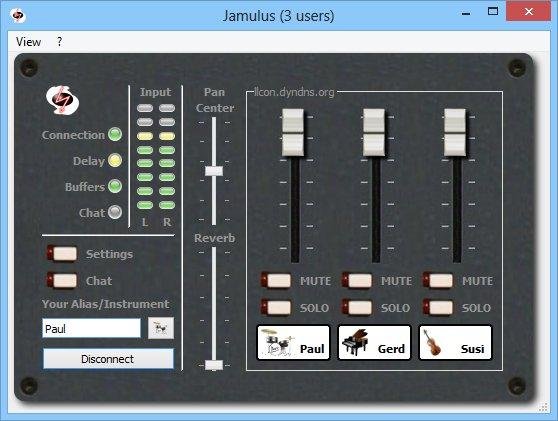
The latest version of Jamulus Internet Jam Session Software, version 3.12.1, has been released, allowing musicians to participate in real-time jam sessions over the Internet. To effectively minimize latency, Jamulus employs compressed audio and utilizes the UDP protocol for audio data transmission. Total latency is influenced by various factors:
1. Network Latency: This is caused by delays within the network, adding approximately 1 ms of latency for every 300 km due to the speed of light.
2. Conversion Latency: Occurs during analog-to-digital or digital-to-analog conversions, particularly if not managed by dedicated hardware.
3. Audio Latency: Results from the physical travel time of sound, introducing a delay of about 3 ms per meter, especially when microphones and speakers are distanced from one another.
Jamulus operates on a client-server model where each client sends compressed audio to an Internet server, which mixes the audio streams for each musician and sends the compressed mix back. Clients can manage their own audio mix via a built-in mixing console.
Servers are classified as either public (Registered) or private (Unregistered), with Registered servers being listed in directories to help users find the lowest latency options. All servers utilize Jamulus server software to manage audio data collection, mixing, and transmission.
For optimal performance, a minimum internet connection speed of 200 kbps is required for both upstream and downstream connections, and the ping time to the server should average no more than 40 ms. A comprehensive software manual is available online for user guidance.
Extension:
With the continuous advancements in technology and the growing demand for remote collaboration, Jamulus plays a pivotal role in connecting musicians worldwide. The latest version not only enhances the user experience but also expands accessibility for musicians of varying skill levels.
In addition to its core features, future updates could introduce enhancements such as improved user interfaces for mixing, integration with virtual instruments, and enhanced collaboration tools. Furthermore, Jamulus could explore expanding its user base by implementing a built-in user authentication system for private servers, ensuring a secure environment for musicians who prefer to jam without public access.
The growing trend of virtual music collaboration signifies the importance of platforms like Jamulus, which bridge geographical gaps and foster creativity in an increasingly digital world. As more musicians seek to collaborate online, Jamulus will likely continue to evolve, incorporating user feedback and technological advancements to remain a leading choice for online jam sessions
1. Network Latency: This is caused by delays within the network, adding approximately 1 ms of latency for every 300 km due to the speed of light.
2. Conversion Latency: Occurs during analog-to-digital or digital-to-analog conversions, particularly if not managed by dedicated hardware.
3. Audio Latency: Results from the physical travel time of sound, introducing a delay of about 3 ms per meter, especially when microphones and speakers are distanced from one another.
Jamulus operates on a client-server model where each client sends compressed audio to an Internet server, which mixes the audio streams for each musician and sends the compressed mix back. Clients can manage their own audio mix via a built-in mixing console.
Servers are classified as either public (Registered) or private (Unregistered), with Registered servers being listed in directories to help users find the lowest latency options. All servers utilize Jamulus server software to manage audio data collection, mixing, and transmission.
For optimal performance, a minimum internet connection speed of 200 kbps is required for both upstream and downstream connections, and the ping time to the server should average no more than 40 ms. A comprehensive software manual is available online for user guidance.
Extension:
With the continuous advancements in technology and the growing demand for remote collaboration, Jamulus plays a pivotal role in connecting musicians worldwide. The latest version not only enhances the user experience but also expands accessibility for musicians of varying skill levels.
In addition to its core features, future updates could introduce enhancements such as improved user interfaces for mixing, integration with virtual instruments, and enhanced collaboration tools. Furthermore, Jamulus could explore expanding its user base by implementing a built-in user authentication system for private servers, ensuring a secure environment for musicians who prefer to jam without public access.
The growing trend of virtual music collaboration signifies the importance of platforms like Jamulus, which bridge geographical gaps and foster creativity in an increasingly digital world. As more musicians seek to collaborate online, Jamulus will likely continue to evolve, incorporating user feedback and technological advancements to remain a leading choice for online jam sessions
Jamulus Internet Jam Session Software 3.12.1 released
Jamulus enables musicians to perform real-time jam sessions over the Internet.
Jamulus Internet Jam Session Software 3.12.1 released @ MajorGeeks