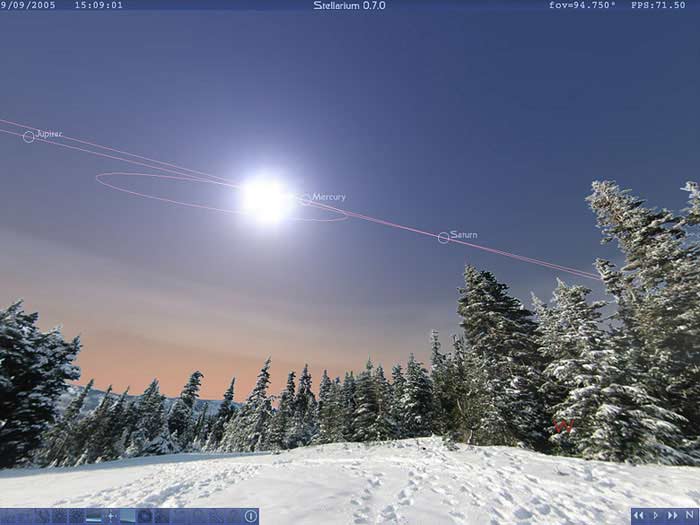
Stellarium 26.2 has been released, enhancing the popular free and open-source planetarium software that offers users a mesmerizing 3D view of the night sky. This software allows users to observe celestial objects as they would appear to the naked eye, through binoculars, or with a telescope, making it suitable for both amateur astronomers and planetarium projectors.
With Stellarium, users can explore a comprehensive catalog of over 600,000 stars by default, and can access additional catalogs containing more than 210 million stars. Features include depictions of asterisms and constellation illustrations, images of nebulae from the complete Messier catalog, a realistic representation of the Milky Way, and lifelike simulations of atmospheric phenomena like sunrise and sunset.
The software is equipped with a powerful zoom capability, time control features, and a multilingual interface. It also supports scripting for users to create and record their own shows, as well as various projection methods for planetarium domes. The user-friendly graphical interface is complemented by extensive keyboard controls, and it allows for telescope integration.
In terms of visualization, Stellarium offers equatorial and azimuthal grids, star twinkling effects, shooting star simulations, and eclipse visualizations. Users can also enjoy skinnable landscapes with spherical panorama projection, adding to the immersive experience.
Customization options further enhance Stellarium's functionality, enabling users to add their own deep-sky objects, landscapes, constellation images, and scripts.
In summary, Stellarium 26.2 continues to be a powerful tool for stargazing and astronomical education, providing an interactive and customizable platform for exploring the universe. Future updates could expand its features even further, perhaps incorporating augmented reality capabilities or real-time data feeds from observatories to enhance the learning experience for users of all ages
With Stellarium, users can explore a comprehensive catalog of over 600,000 stars by default, and can access additional catalogs containing more than 210 million stars. Features include depictions of asterisms and constellation illustrations, images of nebulae from the complete Messier catalog, a realistic representation of the Milky Way, and lifelike simulations of atmospheric phenomena like sunrise and sunset.
The software is equipped with a powerful zoom capability, time control features, and a multilingual interface. It also supports scripting for users to create and record their own shows, as well as various projection methods for planetarium domes. The user-friendly graphical interface is complemented by extensive keyboard controls, and it allows for telescope integration.
In terms of visualization, Stellarium offers equatorial and azimuthal grids, star twinkling effects, shooting star simulations, and eclipse visualizations. Users can also enjoy skinnable landscapes with spherical panorama projection, adding to the immersive experience.
Customization options further enhance Stellarium's functionality, enabling users to add their own deep-sky objects, landscapes, constellation images, and scripts.
In summary, Stellarium 26.2 continues to be a powerful tool for stargazing and astronomical education, providing an interactive and customizable platform for exploring the universe. Future updates could expand its features even further, perhaps incorporating augmented reality capabilities or real-time data feeds from observatories to enhance the learning experience for users of all ages
Stellarium 26.2 released
Stellarium is a free, Open Source planetarium for your computer that shows a realistic sky in stunning 3D. Also available as a Portable version.