Summary:
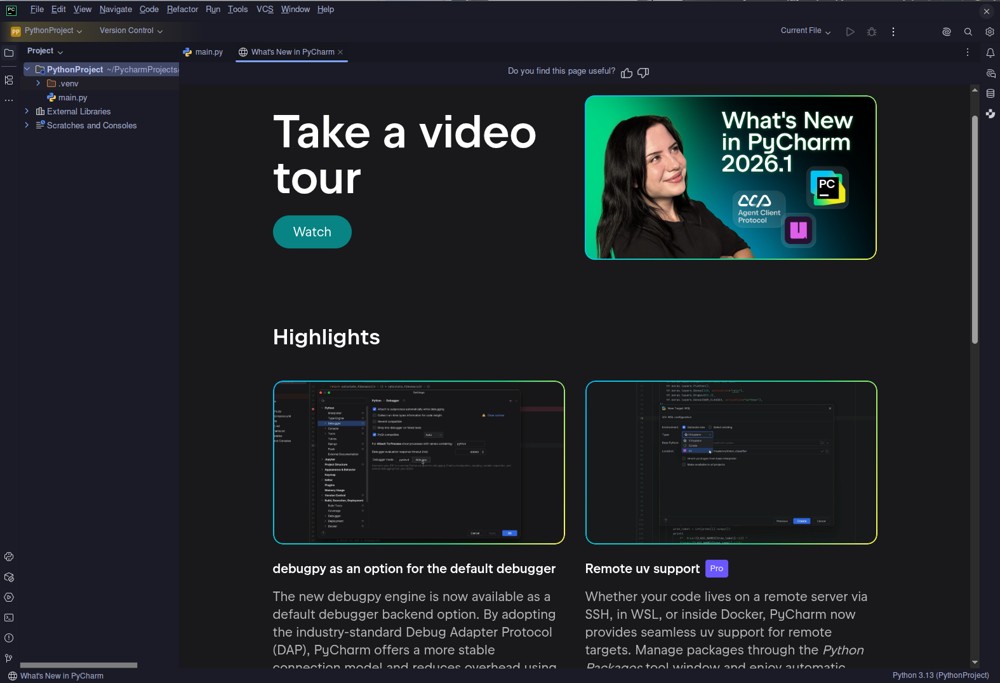
The latest version of PyCharm, 2026.2.1.0, continues to solidify its position as a leading IDE for Python development. It introduces enhanced features such as native support for the latest interpreter versions, improved Docker Compose integration, and a refined integrated terminal. The transition to a unified licensing model means that the core IDE is available for free, while advanced features require a Pro subscription. The installation process is simplified thanks to bundled OpenJDK, and the IDE offers robust code analysis, refactoring tools, and seamless virtual environment management. However, it does have drawbacks, including high memory usage, slower startup times compared to lighter alternatives, and the absence of a built-in GUI designer.
Extended Discussion:
PyCharm's evolution reflects the growing complexity of modern Python development, catering to both individual developers and teams. The unification of Community and Professional editions has streamlined access to essential tools without a financial barrier, making it accessible for hobbyists and newcomers. The Pro subscription, while a cost, unlocks features crucial for professional environments, such as enhanced web framework support and advanced database management tools.
As Python continues to gain traction in fields such as data science, web development, and automation, PyCharm's capabilities are more relevant than ever. Its intelligent code completion and static analysis help developers write efficient code and catch errors early, which is particularly valuable in large codebases. The IDE’s integration with version control systems and its support for unit testing streamline workflows, making it an essential tool for professional developers.
Nonetheless, its memory consumption can be a significant hurdle for users with limited system resources. As Python projects grow in size and complexity, the demand on memory can lead to performance issues, necessitating at least 8 GB of RAM for smooth operation. Additionally, while the IntelliJ platform has made strides in optimizing startup times, it still lags behind lighter editors like VS Code, which may deter some users.
The lack of a drag-and-drop GUI designer can also be a limitation for those working with PyQt or PySide, forcing them to rely on external tools, which disrupts the workflow.
Overall, PyCharm remains the go-to IDE for serious Python development, especially for users engaged in complex projects requiring robust tooling. For beginners or casual developers, lighter alternatives may suffice, but for those committed to advancing their Python skills and building professional applications, PyCharm’s depth and intelligence provide a compelling case for adoption. As JetBrains continues to update and enhance PyCharm, it will likely maintain its status as a vital resource in the Python development landscape
Extended Discussion:
PyCharm's evolution reflects the growing complexity of modern Python development, catering to both individual developers and teams. The unification of Community and Professional editions has streamlined access to essential tools without a financial barrier, making it accessible for hobbyists and newcomers. The Pro subscription, while a cost, unlocks features crucial for professional environments, such as enhanced web framework support and advanced database management tools.
As Python continues to gain traction in fields such as data science, web development, and automation, PyCharm's capabilities are more relevant than ever. Its intelligent code completion and static analysis help developers write efficient code and catch errors early, which is particularly valuable in large codebases. The IDE’s integration with version control systems and its support for unit testing streamline workflows, making it an essential tool for professional developers.
Nonetheless, its memory consumption can be a significant hurdle for users with limited system resources. As Python projects grow in size and complexity, the demand on memory can lead to performance issues, necessitating at least 8 GB of RAM for smooth operation. Additionally, while the IntelliJ platform has made strides in optimizing startup times, it still lags behind lighter editors like VS Code, which may deter some users.
The lack of a drag-and-drop GUI designer can also be a limitation for those working with PyQt or PySide, forcing them to rely on external tools, which disrupts the workflow.
Overall, PyCharm remains the go-to IDE for serious Python development, especially for users engaged in complex projects requiring robust tooling. For beginners or casual developers, lighter alternatives may suffice, but for those committed to advancing their Python skills and building professional applications, PyCharm’s depth and intelligence provide a compelling case for adoption. As JetBrains continues to update and enhance PyCharm, it will likely maintain its status as a vital resource in the Python development landscape
PyCharm 2026.2.1.0 released
PyCharm is the gold standard for serious Python development, adding native support for recent interpreter versions, tightening Docker Compose integration, and refining the integrated terminal to actually feel like a proper shell instead of a half-hearted wrapper.