Meta has released Muse Glimmer, an open-weight 30-billion-parameter model optimized for running local agentic workflows entirely on a single consumer GPU. Thanks to aggressive quantization and speculative decoding, the model handles multi-step automation, coding, and complex reasoning tasks with minimal latency, proving that capable AI no longer requires a cloud subscription.
Meta Releases Muse Glimmer, an Open Agentic AI Model That Runs on Your GPU
Meta is back releasing open weight AI models. The new 30-billion-parameter model is distilled from Meta’s proprietary Muse Spark and ships with aggressive quantization for single-GPU deployment.
Meta dropped the weights for Muse Glimmer today. It is a 30-billion-parameter multimodal language model built specifically to run local agentic workflows on consumer hardware. The model ships under an Apache 2.0 license and, thanks to aggressive quantization, fits comfortably on a single 24GB or 32GB GPU with less than a 1% accuracy hit.
Open-weight AI has spent years racing toward the cloud. Meta is flipping that script with this one. Instead of asking you to rent a data center for routine automation, the company distilled Muse Glimmer from its proprietary Muse Spark foundation model. The result is a compact transformer paired with a ~1.8 billion parameter vision encoder, trained to handle multi-step tool use, function calling, and even failure recovery when a called API breaks.
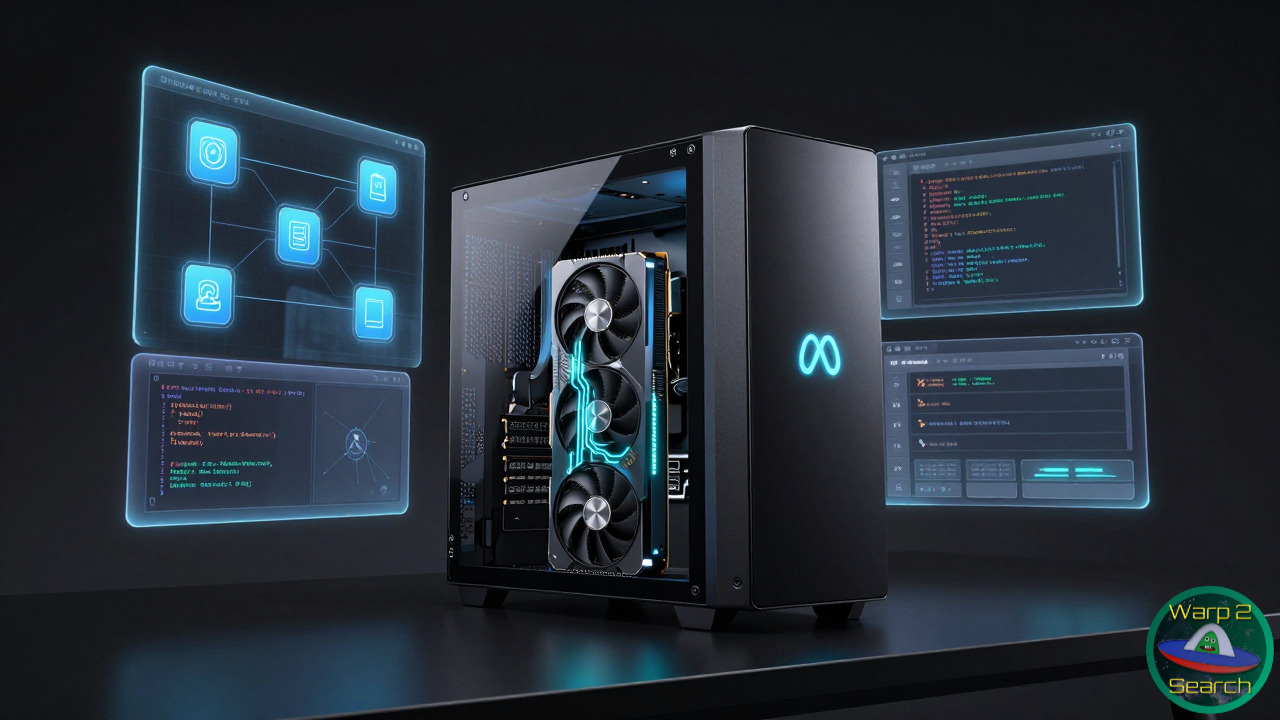
Local Agentic AI, Actually
The architecture holds roughly 29.6 billion parameters across 52 layers with a sliding window of 2,048 tokens. You get 131,072 tokens of interleaved text and image context, support for over 100 languages, and a vocabulary that tops 200,000 tokens. Meta applied a three-phase distillation recipe to squeeze Spark’s capabilities into a package that actually runs on your desktop. Pre-training logit distillation, longer-context agent data, and on-policy reinforcement learning wrapped it up.
Full BF16 precision demands around 64GB of VRAM, which immediately knocks out most gaming rigs. Meta solved that with two quantization variants. K-Quant-Dynamic trims it to 32GB with just a 0.2% accuracy dip. The more aggressive K-Quant-17GB variant shaves it down to 24GB, costing you roughly 1% in performance. Benchmarks confirm the hit is barely noticeable on agentic task suites.
Meta also bundled a DFlash speculative decoder to speed things up. The lightweight drafter predicts 16-token blocks in a single pass, and the main model verifies them in parallel. It delivers a 3.1x speed boost on an RTX 5090, 1.5x on an M4 Max, and 1.8x on an M5 Max. The 1% accuracy drop on 24GB cards is real, and some agentic workflows will still trip up on obscure API endpoints. But for most automation tasks, it is good enough.
You can grab the weights directly from Hugging Face right now. The model plays nicely with Hugging Face Transformers, PyTorch TorchTitan for fine-tuning, and local runners like llama.cpp, MLX, Ollama, LM Studio, and Unsloth. Server-side deployments work through vLLM and SGLang, while cloud providers like Together AI, Fireworks, and OpenRouter have already integrated it. Hardware partners from AMD to Intel to NVIDIA are validating optimized builds.
Benchmarking and the Open-Weight Race
Muse Glimmer was not just tuned for tool use. It also stacks up against the other heavy hitters in the ~30B class. On MCP Atlas, it pulled 75.5 compared to Gemma4-31B’s 54.2 and Qwen3.6-27B’s 62.5. SWE-Bench Pro put it at 51.2, beating Gemma by a wide margin. Reasoning tasks like AIME 2026 landed at 94.7. Those aren’t foundation model numbers. They are local deployment numbers.
It is a rather strong showing for the size, though you should keep in mind that agentic benchmarks often reward specific architectural choices over raw scale. Meta validated the model under its Advanced AI Scaling Framework before release, and it did not cross the threshold for frontier AI since it trails Muse Spark in overall capability. Meta says the model was built to handle failure recovery when external tools break, rather than just assuming every API call will succeed on the first try.
This is the latest piece in Meta’s broader Muse lineup. Muse Spark dropped in April as the proprietary foundation model, followed by Spark 1.1, a specialized Muse Code variant, and Muse Glimmer hitting shelves today. Spark powers Meta AI across Facebook, Instagram, and WhatsApp, while Glimmer is clearly aimed at developers who want that same agent behavior without sending screenshots to a server.
If you thought the open-weight race was slowing down, Alibaba is about to flip the board. We expect Alibaba Cloud to announce Qwen3.8-Max this week, a Mixture-of-Experts model clocking in at roughly 2.4 trillion parameters with open weights. Alongside it, a dense Qwen3.8 variant at around 27 billion parameters will round out the release. It is a massive scale jump from their April Qwen3.6 launch, and it signals that the next generation of local and cloud agents will have even more serious firepower.
The timing says everything. Meta pushing a highly capable, locally deployable agentic model while Alibaba prepares a trillion-plus parameter open release means the ceiling for on-device AI just moved further up the chart. You no longer need a cloud subscription to run multi-step automation, handle broken API calls, or process documents locally.
Head here to download Muse Glimmer on Hugging Face, or check out the accompanying technical briefing for the full distillation recipe and benchmark methodology.
