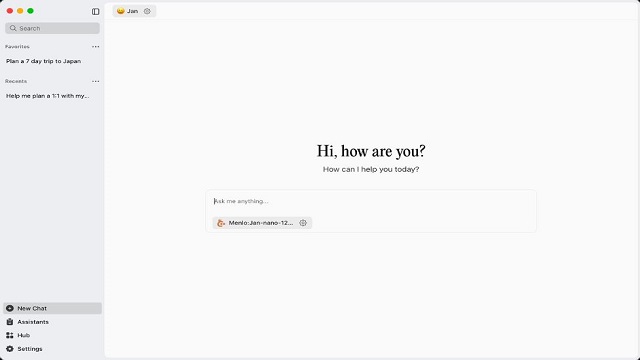
Jan AI is a free and open-source desktop application designed to provide AI chat capabilities similar to ChatGPT, while ensuring that user data remains local and private. Compatible with Windows, Linux, and Mac systems, Jan AI stands out as one of the most user-friendly options for running local language models (LLMs). Its interface is intuitive, enabling users to create projects and engage in AI conversations without prior experience in local AI models. This eliminates the frustrations often associated with setting up other local AI applications that heavily rely on complex configurations involving Python, CUDA, and missing DLLs.
Key Features of Jan AI
- Local Operation: Jan AI keeps all data processing on the user's machine, mitigating privacy concerns related to cloud storage. Users can choose from several popular open-source models, including Llama, Mistral, Qwen, and Gemma, through an easy-to-navigate built-in model hub.
- User-Friendly Interface: The application's design is clean and forgiving, making it easy for beginners to get started without extensive technical knowledge.
- Local API Support: For advanced users, Jan can set up a local server that mimics the functionality of the OpenAI API, allowing compatibility with existing scripts and tools.
- Integration and Project Management: Jan includes connectors for widely used services like Gmail and Slack, enabling seamless interaction with existing workflows. It also allows users to organize chats, files, and tasks into projects, preventing clutter.
Potential Use Cases
Jan AI appeals to various user groups, including:
- Writers seeking offline drafting and brainstorming tools.
- Developers looking to experiment with prompts or create local AI applications.
- Researchers handling sensitive information who prioritize data security.
- Individuals with unstable internet connections who still want reliable AI access.
- Users who prefer free software over subscription-based models.
Performance Considerations
While Jan AI offers many advantages, it also has limitations:
- The quality of AI responses can vary based on the selected model, as open-source LLMs continue to evolve.
- Higher-end hardware is often necessary for running larger models effectively, which may present challenges for users with older machines.
- Some performance optimization may be required to achieve the best results.
Conclusion
Jan AI 0.8.0 strikes a commendable balance between functionality and usability. It is a robust, privacy-focused alternative to cloud-based AI tools, providing an effective local solution for users. The application’s simplicity, combined with the flexibility of local model execution and optional cloud support, makes it an attractive choice for those seeking an accessible entry point into AI chat technology. However, users should be mindful of hardware requirements and the varying quality of available models, as these factors can impact overall performance.
Future Directions
Moving forward, the Jan AI team may focus on improving model quality, enhancing compatibility with a broader range of hardware, and introducing new features based on user feedback. As the open-source community continues to innovate, Jan AI has the potential to evolve into an even more powerful and versatile tool for AI enthusiasts and professionals alike
Key Features of Jan AI
- Local Operation: Jan AI keeps all data processing on the user's machine, mitigating privacy concerns related to cloud storage. Users can choose from several popular open-source models, including Llama, Mistral, Qwen, and Gemma, through an easy-to-navigate built-in model hub.
- User-Friendly Interface: The application's design is clean and forgiving, making it easy for beginners to get started without extensive technical knowledge.
- Local API Support: For advanced users, Jan can set up a local server that mimics the functionality of the OpenAI API, allowing compatibility with existing scripts and tools.
- Integration and Project Management: Jan includes connectors for widely used services like Gmail and Slack, enabling seamless interaction with existing workflows. It also allows users to organize chats, files, and tasks into projects, preventing clutter.
Potential Use Cases
Jan AI appeals to various user groups, including:
- Writers seeking offline drafting and brainstorming tools.
- Developers looking to experiment with prompts or create local AI applications.
- Researchers handling sensitive information who prioritize data security.
- Individuals with unstable internet connections who still want reliable AI access.
- Users who prefer free software over subscription-based models.
Performance Considerations
While Jan AI offers many advantages, it also has limitations:
- The quality of AI responses can vary based on the selected model, as open-source LLMs continue to evolve.
- Higher-end hardware is often necessary for running larger models effectively, which may present challenges for users with older machines.
- Some performance optimization may be required to achieve the best results.
Conclusion
Jan AI 0.8.0 strikes a commendable balance between functionality and usability. It is a robust, privacy-focused alternative to cloud-based AI tools, providing an effective local solution for users. The application’s simplicity, combined with the flexibility of local model execution and optional cloud support, makes it an attractive choice for those seeking an accessible entry point into AI chat technology. However, users should be mindful of hardware requirements and the varying quality of available models, as these factors can impact overall performance.
Future Directions
Moving forward, the Jan AI team may focus on improving model quality, enhancing compatibility with a broader range of hardware, and introducing new features based on user feedback. As the open-source community continues to innovate, Jan AI has the potential to evolve into an even more powerful and versatile tool for AI enthusiasts and professionals alike
Jan AI 0.8.0 released
Jan is a free, Open Source AI chat application that runs directly on your computer (Windows, Linux, Mac), giving you ChatGPT-like abilities without sending your data to the cloud.