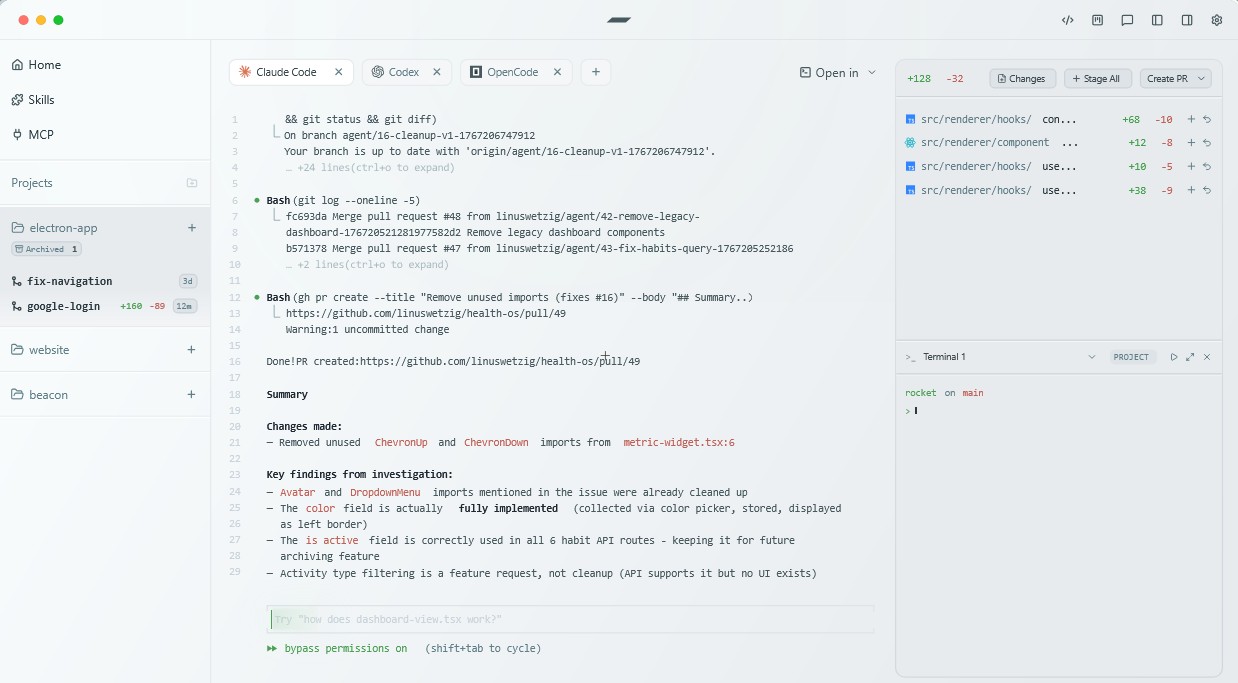
Emdash 1.1.35 has been released, introducing an innovative open-source development environment designed to help developers manage multiple AI coding agents from a single, centralized interface. This platform is compatible with Windows, Mac, and Linux, allowing users to run agents in parallel, each within its own isolated Git worktree. This setup not only enhances productivity but also streamlines project organization by enabling easy review of changes without the need to toggle between multiple terminal windows.
The tool is particularly beneficial for developers engaged in AI-assisted coding or those handling large projects, as Emdash facilitates the simultaneous operation of multiple agents on various tasks. By offering a centralized workspace, it alleviates the chaos of managing numerous assistants, branches, and terminals, allowing developers to delegate distinct tasks to different agents and track their progress through an intuitive dashboard.
Emdash supports a wide range of AI coding assistants, including Claude Code, Codex, Gemini, and GitHub Copilot, providing users with the flexibility to experiment with different models suited for specific tasks. It also features a built-in Kanban-style task management system and a diff viewer to simplify tracking each agent's progress and outputs, thereby minimizing context switching and enhancing overall efficiency.
Key features of Emdash include:
- The ability to run multiple coding agents in parallel.
- Isolated Git worktrees for each task, minimizing conflicts.
- Support for over 20 AI coding agents.
- A built-in diff viewer for reviewing changes.
- A Kanban-style task management interface.
- Integration with tools like GitHub Issues, Jira, Linear, and GitLab.
- Remote project support via SSH.
- A built-in file editor and optional tmux session persistence.
- Open-source and cross-platform compatibility.
Real-world use cases illustrate Emdash's potential in streamlining development tasks such as bug fixing, code refactoring, and documentation creation by allowing simultaneous deployment of agents for each task. The remote SSH support also caters to developers working on cloud servers, enhancing productivity by offloading intensive processes to remote environments.
While Emdash offers an excellent workflow for managing multiple AI agents and strong Git integration, it is most beneficial for developers already employing AI coding tools. New users might find the advanced features slightly overwhelming due to the requirement for familiarity with Git workflows.
In conclusion, Emdash represents a significant advancement for developers looking to optimize their interactions with AI coding assistants. By enabling coordination between multiple agents through a cohesive interface, it can significantly improve workflows, particularly for users already utilizing powerful tools like Claude Code, Codex, Gemini, or Copilot. The adoption of Emdash can lead to a more organized and efficient coding experience, keeping Git history clean and manageable.
As Emdash continues to evolve, developers can anticipate further enhancements that will refine their experience and capability in managing AI-assisted development tasks
The tool is particularly beneficial for developers engaged in AI-assisted coding or those handling large projects, as Emdash facilitates the simultaneous operation of multiple agents on various tasks. By offering a centralized workspace, it alleviates the chaos of managing numerous assistants, branches, and terminals, allowing developers to delegate distinct tasks to different agents and track their progress through an intuitive dashboard.
Emdash supports a wide range of AI coding assistants, including Claude Code, Codex, Gemini, and GitHub Copilot, providing users with the flexibility to experiment with different models suited for specific tasks. It also features a built-in Kanban-style task management system and a diff viewer to simplify tracking each agent's progress and outputs, thereby minimizing context switching and enhancing overall efficiency.
Key features of Emdash include:
- The ability to run multiple coding agents in parallel.
- Isolated Git worktrees for each task, minimizing conflicts.
- Support for over 20 AI coding agents.
- A built-in diff viewer for reviewing changes.
- A Kanban-style task management interface.
- Integration with tools like GitHub Issues, Jira, Linear, and GitLab.
- Remote project support via SSH.
- A built-in file editor and optional tmux session persistence.
- Open-source and cross-platform compatibility.
Real-world use cases illustrate Emdash's potential in streamlining development tasks such as bug fixing, code refactoring, and documentation creation by allowing simultaneous deployment of agents for each task. The remote SSH support also caters to developers working on cloud servers, enhancing productivity by offloading intensive processes to remote environments.
While Emdash offers an excellent workflow for managing multiple AI agents and strong Git integration, it is most beneficial for developers already employing AI coding tools. New users might find the advanced features slightly overwhelming due to the requirement for familiarity with Git workflows.
In conclusion, Emdash represents a significant advancement for developers looking to optimize their interactions with AI coding assistants. By enabling coordination between multiple agents through a cohesive interface, it can significantly improve workflows, particularly for users already utilizing powerful tools like Claude Code, Codex, Gemini, or Copilot. The adoption of Emdash can lead to a more organized and efficient coding experience, keeping Git history clean and manageable.
As Emdash continues to evolve, developers can anticipate further enhancements that will refine their experience and capability in managing AI-assisted development tasks
Emdash 1.1.35 released
Emdash is a free, Open Source agentic development environment designed to help developers efficiently manage multiple AI coding agents from a centralized dashboard.