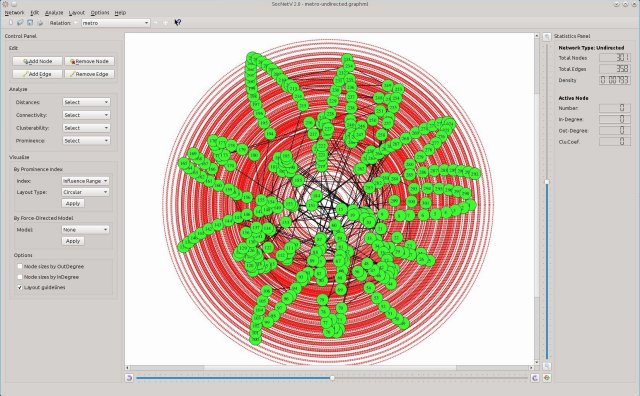
The Social Network Visualizer (SocNetV) has recently released its version 3.6, enhancing its capabilities as a powerful application for social network analysis and visualization. SocNetV allows users to create and analyze social networks by drawing graphs or importing existing data from various formats such as GraphML, UCINET, and Pajek. The application excels in computing key metrics such as cohesion, centrality, community structures, and structural equivalence, employing diverse layout algorithms that prioritize actor centrality and prestige scores, including Eigenvector and Betweenness centrality.
Key features of the latest version of SocNetV include:
- Automatic generation of well-known network datasets.
- Support for random network models, such as scale-free, Erdős–Rényi, and Watts-Strogatz models.
- Compatibility with multiple social network formats, enabling extensive data import and export capabilities.
- Efficient handling of two-mode affiliation networks presented in sociomatrix format.
- Rapid calculation of various centrality indices, including Degree, Closeness, and Betweenness, alongside Prestige metrics like Proximity and Rank.
- Advanced layout options based on centrality and prominence indices, including radial and leveled network layouts.
- Web crawling features to dynamically create networks from online sources.
- Comprehensive analysis tools, including Triad and Clique Census, along with structural equivalence methods such as hierarchical cluster analysis and actor similarity metrics.
- User-friendly export options in formats like GraphML and Pajek, ensuring seamless integration with other tools.
- An online manual and technical documentation for user guidance.
- Efficient performance, capable of handling large networks with over 1000 actors and 10,000 edges while utilizing minimal memory and CPU resources.
- Support for both graph and digraph modalities.
As the field of social network analysis continues to grow, SocNetV remains an essential tool for researchers and practitioners alike, providing robust features for in-depth analysis and visualization of complex social structures. Its continual updates and enhancements ensure that users have access to cutting-edge technology to support their analytical needs. Future versions may further expand on these capabilities, integrating machine learning techniques or enhanced visualization options to better interpret intricate social interactions
Key features of the latest version of SocNetV include:
- Automatic generation of well-known network datasets.
- Support for random network models, such as scale-free, Erdős–Rényi, and Watts-Strogatz models.
- Compatibility with multiple social network formats, enabling extensive data import and export capabilities.
- Efficient handling of two-mode affiliation networks presented in sociomatrix format.
- Rapid calculation of various centrality indices, including Degree, Closeness, and Betweenness, alongside Prestige metrics like Proximity and Rank.
- Advanced layout options based on centrality and prominence indices, including radial and leveled network layouts.
- Web crawling features to dynamically create networks from online sources.
- Comprehensive analysis tools, including Triad and Clique Census, along with structural equivalence methods such as hierarchical cluster analysis and actor similarity metrics.
- User-friendly export options in formats like GraphML and Pajek, ensuring seamless integration with other tools.
- An online manual and technical documentation for user guidance.
- Efficient performance, capable of handling large networks with over 1000 actors and 10,000 edges while utilizing minimal memory and CPU resources.
- Support for both graph and digraph modalities.
As the field of social network analysis continues to grow, SocNetV remains an essential tool for researchers and practitioners alike, providing robust features for in-depth analysis and visualization of complex social structures. Its continual updates and enhancements ensure that users have access to cutting-edge technology to support their analytical needs. Future versions may further expand on these capabilities, integrating machine learning techniques or enhanced visualization options to better interpret intricate social interactions
Social Network Visualizer 3.6 released
Social Network Visualizer (SocNetV) is a social network analysis and visualization application.