JetBrains has released Rider version 2026.2.1, a powerful cross-platform Integrated Development Environment (IDE) specifically designed for .NET developers. Rider combines deep code insight with robust performance and seamless integration with both modern and legacy tools, making it an attractive alternative for developers who may find Visual Studio sluggish.
Rider is built on the same foundation as other JetBrains IDEs like IntelliJ IDEA and PyCharm, providing a familiar interface for users. It offers a clean, customizable environment that is optimized for performance, even on extensive projects, making it particularly appealing to freelancers and indie developers. The IDE comes equipped with a range of features including a built-in terminal, templates, version control, and live code snippets.
Key features of Rider include:
- Support for various frameworks such as .NET Framework, .NET Core, Mono, Xamarin, and ASP.NET, as well as front-end technologies like JavaScript and React, and tools like SQL and Docker.
- Advanced code analysis and refactoring capabilities with over 2200 code inspections and 1000+ context actions to help developers identify and resolve issues early in the development process.
- A fast debugger and test runner compatible with multiple testing frameworks like NUnit and MSTest.
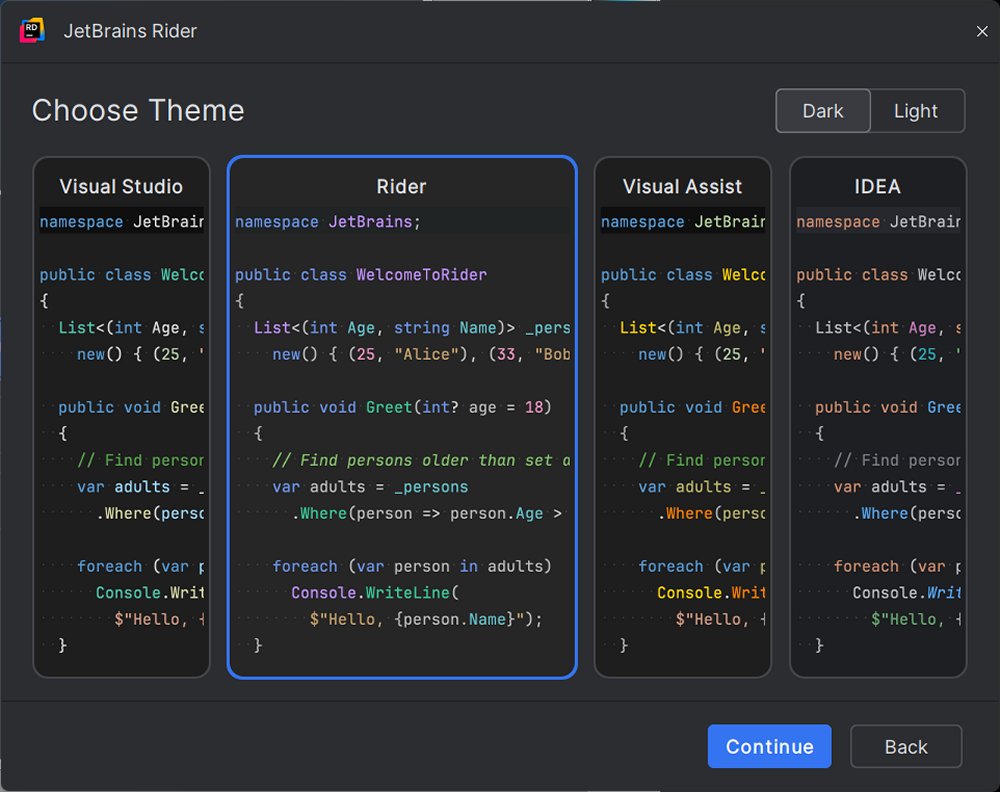
- An intuitive user interface that provides smart code suggestions, customizable layouts, and a proper dark mode.
Rider is versatile, supporting a wide array of applications from web development to game development with Unity, Unreal Engine, and Godot. For developers transitioning from Visual Studio, Rider can directly open existing solution and project files without requiring extensive reconfiguration, although some adjustments may be necessary for keybindings and UI layout.
System requirements for Rider include compatibility with Windows, macOS, and Linux, requiring .NET Framework 4.6.1 or later. The IDE is free for non-commercial use, such as educational or open-source projects, with a commercial version available starting at $149 per year after a 30-day free trial.
Pros include Rider's speed, built-in ReSharper functionality, comprehensive support for various frameworks, and excellent version control and database tools. However, initial indexing can be time-consuming for large solutions, and users may need some time to adjust to the new environment if transitioning from Visual Studio.
In conclusion, JetBrains Rider 2026.2.1 is an ideal choice for developers seeking a fast, efficient, and customizable IDE that enhances the software development experience. It is especially well-suited for those working with large .NET solutions or in Unity development, providing a streamlined approach to building software while minimizing distractions. As the IDE continues to evolve, users can expect ongoing improvements and features that cater to the ever-changing landscape of software development
Rider is built on the same foundation as other JetBrains IDEs like IntelliJ IDEA and PyCharm, providing a familiar interface for users. It offers a clean, customizable environment that is optimized for performance, even on extensive projects, making it particularly appealing to freelancers and indie developers. The IDE comes equipped with a range of features including a built-in terminal, templates, version control, and live code snippets.
Key features of Rider include:
- Support for various frameworks such as .NET Framework, .NET Core, Mono, Xamarin, and ASP.NET, as well as front-end technologies like JavaScript and React, and tools like SQL and Docker.
- Advanced code analysis and refactoring capabilities with over 2200 code inspections and 1000+ context actions to help developers identify and resolve issues early in the development process.
- A fast debugger and test runner compatible with multiple testing frameworks like NUnit and MSTest.
- An intuitive user interface that provides smart code suggestions, customizable layouts, and a proper dark mode.
Rider is versatile, supporting a wide array of applications from web development to game development with Unity, Unreal Engine, and Godot. For developers transitioning from Visual Studio, Rider can directly open existing solution and project files without requiring extensive reconfiguration, although some adjustments may be necessary for keybindings and UI layout.
System requirements for Rider include compatibility with Windows, macOS, and Linux, requiring .NET Framework 4.6.1 or later. The IDE is free for non-commercial use, such as educational or open-source projects, with a commercial version available starting at $149 per year after a 30-day free trial.
Pros include Rider's speed, built-in ReSharper functionality, comprehensive support for various frameworks, and excellent version control and database tools. However, initial indexing can be time-consuming for large solutions, and users may need some time to adjust to the new environment if transitioning from Visual Studio.
In conclusion, JetBrains Rider 2026.2.1 is an ideal choice for developers seeking a fast, efficient, and customizable IDE that enhances the software development experience. It is especially well-suited for those working with large .NET solutions or in Unity development, providing a streamlined approach to building software while minimizing distractions. As the IDE continues to evolve, users can expect ongoing improvements and features that cater to the ever-changing landscape of software development
Rider 2026.2.1 released
JetBrains Rider is a cross-platform .NET IDE built for serious developers who want deep code insight, fast performance, and smooth integration tailored for .NET and C#.