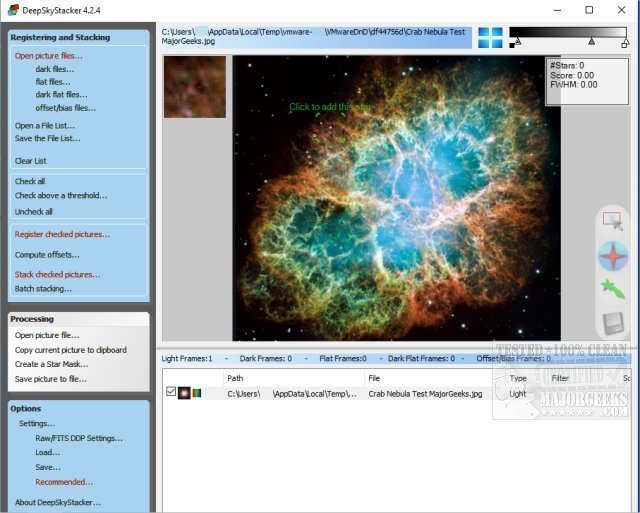
DeepSkyStacker has released version 6.2.0, a powerful tool designed specifically for astrophotographers to simplify the pre-processing of their images. After a night of capturing photographs, users can input various types of images—light frames, dark frames, offset/bias frames, and flat frames—into the application. DeepSkyStacker processes these images, allowing users to preview the outcomes and initiate post-processing.
The software boasts a comprehensive suite of features essential for image processing. It automatically detects stars across the entire image area and identifies dark, flat, and offset frames based on ISO speed and exposure time. Key features include:
- Automatic registration and detection of a set of images.
- Subpixel registration and alignment.
- Support for multiple bitmap formats, including TIFF, FITS, JPEG, BMP, and PNG.
- Native support for RAW files from most DSLRs, ensuring direct processing without intermediate formats.
- Various stacking methods such as average, median, and kappa-sigma clipping.
- Tools for simple post-processing, including adjustments for RGB levels and luminance curves.
- An intuitive user interface that optimizes memory usage and processor capabilities for efficient operation.
Advanced features enhance the application's functionality, including automatic calibration for darks, flats, and offsets, options for detecting and cleaning hot and cold pixels, and the ability to create file lists for frequently used sets of images. The software also includes comet stacking capabilities, and users can execute batch processing for multiple stacks.
This update positions DeepSkyStacker as a critical tool for astrophotographers seeking to streamline their workflow and improve the quality of their images. As the software continues to evolve, it is likely to incorporate even more features that cater to the needs of the astrophotography community.
In addition to DeepSkyStacker's impressive capabilities, users may find value in exploring related tools and guides that enhance photo management and editing within Windows 10 and 11, such as restoring the Windows Photo Viewer or adjusting slideshow settings
The software boasts a comprehensive suite of features essential for image processing. It automatically detects stars across the entire image area and identifies dark, flat, and offset frames based on ISO speed and exposure time. Key features include:
- Automatic registration and detection of a set of images.
- Subpixel registration and alignment.
- Support for multiple bitmap formats, including TIFF, FITS, JPEG, BMP, and PNG.
- Native support for RAW files from most DSLRs, ensuring direct processing without intermediate formats.
- Various stacking methods such as average, median, and kappa-sigma clipping.
- Tools for simple post-processing, including adjustments for RGB levels and luminance curves.
- An intuitive user interface that optimizes memory usage and processor capabilities for efficient operation.
Advanced features enhance the application's functionality, including automatic calibration for darks, flats, and offsets, options for detecting and cleaning hot and cold pixels, and the ability to create file lists for frequently used sets of images. The software also includes comet stacking capabilities, and users can execute batch processing for multiple stacks.
This update positions DeepSkyStacker as a critical tool for astrophotographers seeking to streamline their workflow and improve the quality of their images. As the software continues to evolve, it is likely to incorporate even more features that cater to the needs of the astrophotography community.
In addition to DeepSkyStacker's impressive capabilities, users may find value in exploring related tools and guides that enhance photo management and editing within Windows 10 and 11, such as restoring the Windows Photo Viewer or adjusting slideshow settings
DeepSkyStacker 6.2.0 released
DeepSkyStacker is geared toward astrophotographers and provides a simplified option for pre-processing images.