
OpenAI has officially launched the Codex Micro, a $230 programmable macro pad co-designed with Work Louder to streamline multi-agent coding workflows. This limited-run developer-focused device marks the company's low-risk entry into branded hardware, moving past years of rumors about consumer smart speakers.
OpenAI launches Codex Micro, a $230 macro pad for AI coding
The AI giant's first branded hardware is a limited-run device co-designed with Work Louder, targeting developers more than consumers.
OpenAI has finally confirmed its first branded hardware product. Following years of speculation pointing toward a consumer smart speaker or wearable, OpenAI debuted the Codex Micro on July 15, 2026, at the AI Engineer World Fair in San Francisco. It's a $230 programmable macro pad designed to sit on your desk and manage your Codex AI coding agents.
The device features 13 mechanical switches, a planar joystick, a touch sensor, and a rotary encoder. If you're into custom firmware, it's QMK-based with VIA configurator support. That means you can remap keys in real-time without reflashing. The build is CNC-machined polycarbonate and aluminum. You get 31 PBT keycaps out of the box, including the full 32-icon Codex keyset and 11 solid-color options.
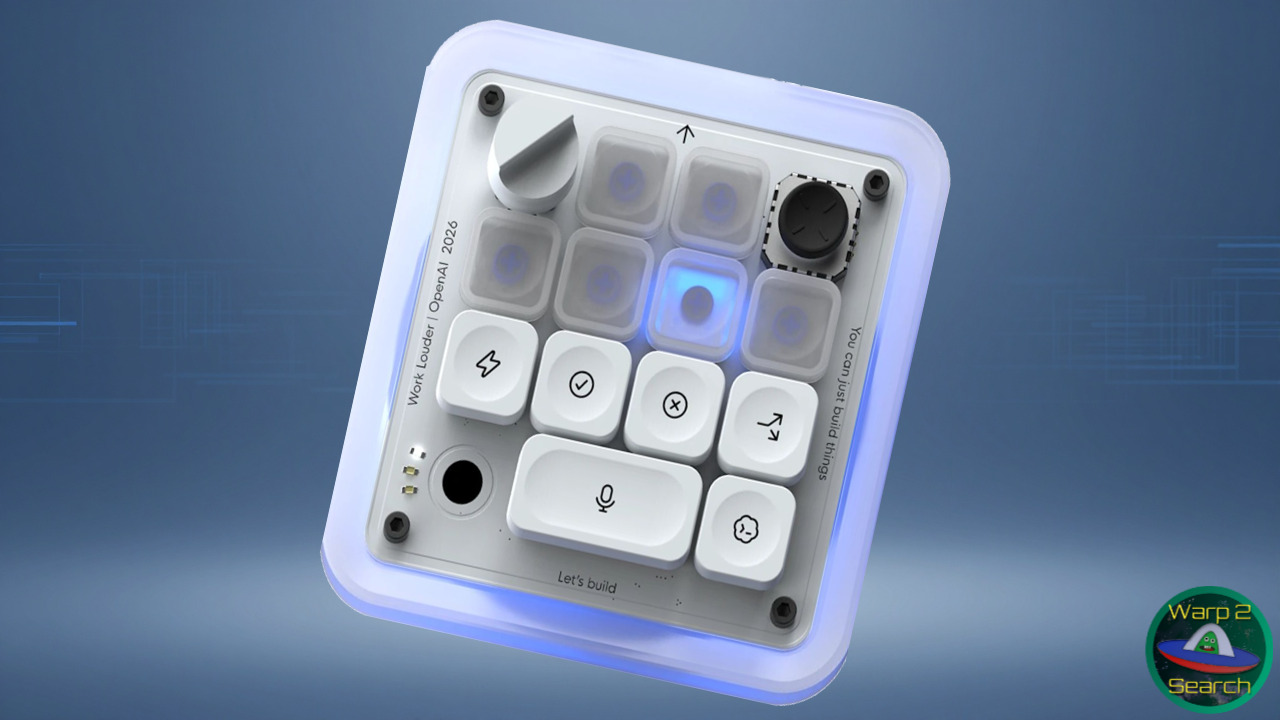
The headline feature is the six frosted, translucent keys on the top two rows. These serve as agent status monitors. Tap a lit key to bring the corresponding Codex thread to the foreground. The color coding is specific:
- Blue: Codex is thinking or processing.
- Green: Task complete.
- Amber: Requires human feedback or decision.
- Red: Error encountered.
- Indigo: Idle agent.
- Light Pink: User approval or input required.
- Pink: Error state.
The price of the Codex Micro is one of the immediate questions. $230. For a macro pad. OpenAI co-designed this with Work Louder, a specialty keyboard maker known for the Creator Micro 2. That base model retails for roughly $174 to $199. The Codex Micro adds the frosted RGB keys, custom firmware, and OpenAI branding. It's a premium, but not an outrageous one, if you compare it to other branded peripherals.
However, the community isn't buying it. Forums are already lit with comments comparing the $230 price tag to a $5 Raspberry Pi Pico. "Why pay $230 when you can tinker for free?" the critics ask. It's a rather expensive piece of hardware for what it offers, though the build quality and specific workflow integration do make a case for it. OpenAI says the device is a "limited-run collaboration" available "while supplies last." Long-term availability remains uncertain.
The Delayed Consumer Device
The Codex Micro is not the device everyone expected. Rumors have circulated for over a year about OpenAI's hardware ambitions, specifically a screenless wearable or smart speaker co-developed with former Apple design chief Jony Ive. That device is still in the works. It's now expected to ship in early 2027, delayed from a late-2026 target.
The timeline has been messy. OpenAI acquired Ive's LoveFrom in May 2025 for $6.5 billion. By October 2025, the Financial Times reported technical and design hurdles. The Apple lawsuit over trade secrets filed in June 2026 adds another layer of complexity. OpenAI is clearly moving carefully here. This macro pad is a low-risk entry. It tests manufacturing relationships. It generates revenue. It builds brand visibility while the Ive gadget matures.
We got to spend time with the Codex Micro at the AI Engineer World Fair, and the rotary dial for adjusting agent reasoning feels snappy. The dial effectively controls how much time and computing power an agent dedicates to a given task. The six command keys below the agent keys handle approve/reject actions by default. If you run multiple agents, seeing their status at a glance saves context-switching. It's optimized for Codex, but it also functions as a standard HID keyboard.
Strategic Bridge
Why start with a macro pad? It's a stepping stone. OpenAI needs to prove it can design and manufacture branded hardware without a catastrophic failure. The Codex Micro does that. It also provides real-world data on how developers interact with AI agent hardware. If you're a Codex power user, the physical controls might justify the cost. Tapping a key to approve a change without alt-tabbing is genuinely useful for flow.
Otherwise, you're paying for a sticker. The Codex Micro is based on existing Work Louder hardware with firmware and cosmetic tweaks. For what it's worth, the limited-run status makes it a collector's item for some, but a hard sell for others.
OpenAI's roadmap hints at a ChatGPT-powered smart speaker down the line. The Codex Micro is just the first chapter. Orders are accepted now with shipping expected "shortly after purchase."
Head here to check availability. Just don't expect this to last forever.
