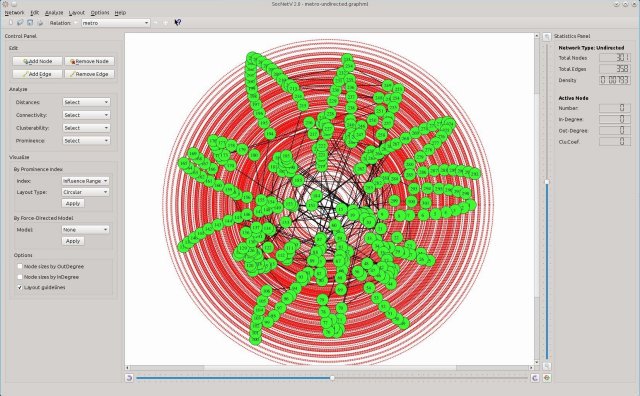
Social Network Visualizer (SocNetV) version 3.3 has been released, offering an advanced platform for social network analysis and visualization. This application allows users to create or load social networks in various formats, including GraphML, UCINET, and Pajek. It features a range of analytical capabilities, such as calculating cohesion, centrality, community, and structural equivalence metrics, and employs multiple layout algorithms that prioritize actor centrality or prestige scores.
Key features of SocNetV include:
- Automatic generation of known network datasets.
- Support for various random network models, such as scale-free and Erdős–Rényi models, as well as Watts-Strogatz small worlds and d-regular networks.
- Compatibility with major social network formats and two-mode affiliation networks.
- Efficient computation of centrality indices (such as Degree, Closeness, and Betweenness) and prestige scores.
- Various network layout options based on centrality and prominence measures, including radial and leveled layouts.
- The ability to crawl websites to generate networks.
- Comprehensive structural equivalence methods, including hierarchical clustering and actor similarity analysis.
- Options for exporting data in multiple formats, including GraphML and Pajek.
- Availability of online manuals and technical documentation to assist users.
- Capability to handle large networks with over 1,000 actors and 10,000 edges while maintaining low memory and CPU usage.
In addition to these features, SocNetV 3.3 may introduce enhancements in user interface design, improved performance for handling larger datasets, and more robust analytical tools. The ongoing development of SocNetV reflects an increasing interest in social network analysis across various fields, such as sociology, marketing, and information science. Users can expect continuous updates that incorporate feedback from the community, ensuring that the application meets evolving research needs
Key features of SocNetV include:
- Automatic generation of known network datasets.
- Support for various random network models, such as scale-free and Erdős–Rényi models, as well as Watts-Strogatz small worlds and d-regular networks.
- Compatibility with major social network formats and two-mode affiliation networks.
- Efficient computation of centrality indices (such as Degree, Closeness, and Betweenness) and prestige scores.
- Various network layout options based on centrality and prominence measures, including radial and leveled layouts.
- The ability to crawl websites to generate networks.
- Comprehensive structural equivalence methods, including hierarchical clustering and actor similarity analysis.
- Options for exporting data in multiple formats, including GraphML and Pajek.
- Availability of online manuals and technical documentation to assist users.
- Capability to handle large networks with over 1,000 actors and 10,000 edges while maintaining low memory and CPU usage.
In addition to these features, SocNetV 3.3 may introduce enhancements in user interface design, improved performance for handling larger datasets, and more robust analytical tools. The ongoing development of SocNetV reflects an increasing interest in social network analysis across various fields, such as sociology, marketing, and information science. Users can expect continuous updates that incorporate feedback from the community, ensuring that the application meets evolving research needs
Social Network Visualizer 3.3 released
Social Network Visualizer (SocNetV) is a social network analysis and visualization application.