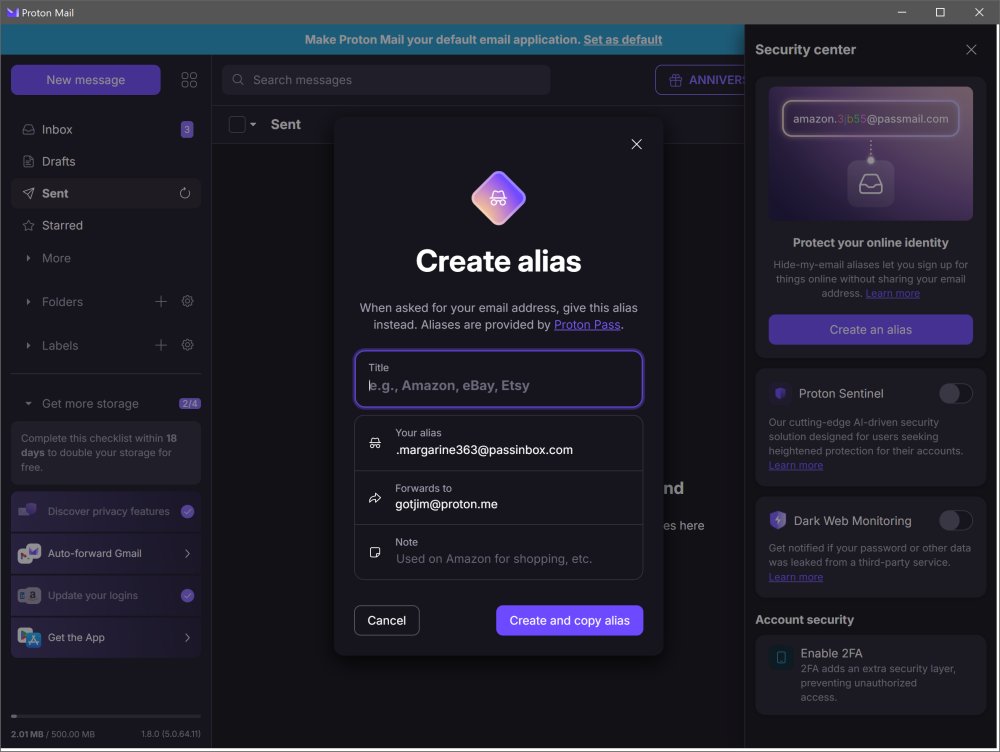
Proton Mail has recently released version 1.12.1, reaffirming its position as a privacy-focused email service. It caters to users who wish to escape the clutches of big tech companies like Google, which often monetize user data through targeted advertising. Developed by scientists from CERN and based in Switzerland, Proton Mail employs end-to-end encryption and a strict no-logs policy, ensuring that not even the service itself can access users' messages.
Key features of Proton Mail include:
- Accessibility through web browsers and dedicated apps for various platforms (Windows, Linux, iOS, and Android).
- End-to-end encryption, ensuring that only senders and recipients can read the emails.
- A zero-access architecture that encrypts data beyond the service's ability to decrypt it.
- A no-ads policy, meaning user data is not sold or scanned for ad targeting.
- Self-destructing emails that can automatically delete after a set time.
- Robust spam filtering and anti-phishing features.
- Two-factor authentication for added account security.
- Integration options for paid users, including access to Proton VPN, Proton Drive, and Proton Calendar.
Proton Mail also supports email aliases, allowing users to create secondary addresses that funnel into their main inbox. This feature helps maintain privacy when signing up for newsletters or services, as well as keeping work and personal communications separate.
The free plan offered by Proton Mail includes one email address, 1 GB of storage, and access to Proton Calendar and Proton Drive with a combined 5 GB of space. While the free tier provides excellent privacy features, upgrading to a paid plan unlocks additional benefits, such as increased storage up to 500 GB, multiple email addresses, advanced filters, and integration with email clients via Proton Mail Bridge.
Proton Mail presents a strong alternative to Gmail, which, despite its extensive features, compromises user privacy by tracking activities and serving ads. Proton Mail's commitment to user privacy, bolstered by its open-source nature and Swiss legal protections, makes it a preferred choice for privacy-conscious individuals.
However, it’s worth noting that Proton Mail lacks the seamless single-click login feature that some mainstream services offer. Users may need to log in using their email address, which is arguably more secure. For those seeking convenience, a mixed approach—using Gmail for logins while handling actual correspondence through Proton Mail—could be optimal.
In conclusion, Proton Mail is a robust option for anyone prioritizing privacy in their email communications. Its strong encryption, user-friendly interface, and solid free plan make it an attractive choice, especially for those managing sensitive information. The paid tiers further enhance the experience with additional features and capabilities, appealing to professionals and privacy advocates alike
Key features of Proton Mail include:
- Accessibility through web browsers and dedicated apps for various platforms (Windows, Linux, iOS, and Android).
- End-to-end encryption, ensuring that only senders and recipients can read the emails.
- A zero-access architecture that encrypts data beyond the service's ability to decrypt it.
- A no-ads policy, meaning user data is not sold or scanned for ad targeting.
- Self-destructing emails that can automatically delete after a set time.
- Robust spam filtering and anti-phishing features.
- Two-factor authentication for added account security.
- Integration options for paid users, including access to Proton VPN, Proton Drive, and Proton Calendar.
Proton Mail also supports email aliases, allowing users to create secondary addresses that funnel into their main inbox. This feature helps maintain privacy when signing up for newsletters or services, as well as keeping work and personal communications separate.
The free plan offered by Proton Mail includes one email address, 1 GB of storage, and access to Proton Calendar and Proton Drive with a combined 5 GB of space. While the free tier provides excellent privacy features, upgrading to a paid plan unlocks additional benefits, such as increased storage up to 500 GB, multiple email addresses, advanced filters, and integration with email clients via Proton Mail Bridge.
Proton Mail presents a strong alternative to Gmail, which, despite its extensive features, compromises user privacy by tracking activities and serving ads. Proton Mail's commitment to user privacy, bolstered by its open-source nature and Swiss legal protections, makes it a preferred choice for privacy-conscious individuals.
However, it’s worth noting that Proton Mail lacks the seamless single-click login feature that some mainstream services offer. Users may need to log in using their email address, which is arguably more secure. For those seeking convenience, a mixed approach—using Gmail for logins while handling actual correspondence through Proton Mail—could be optimal.
In conclusion, Proton Mail is a robust option for anyone prioritizing privacy in their email communications. Its strong encryption, user-friendly interface, and solid free plan make it an attractive choice, especially for those managing sensitive information. The paid tiers further enhance the experience with additional features and capabilities, appealing to professionals and privacy advocates alike
Proton Mail 1.12.1 released
Proton Mail offers a refreshing change if you're tired of your inbox being a data mine for advertisers.