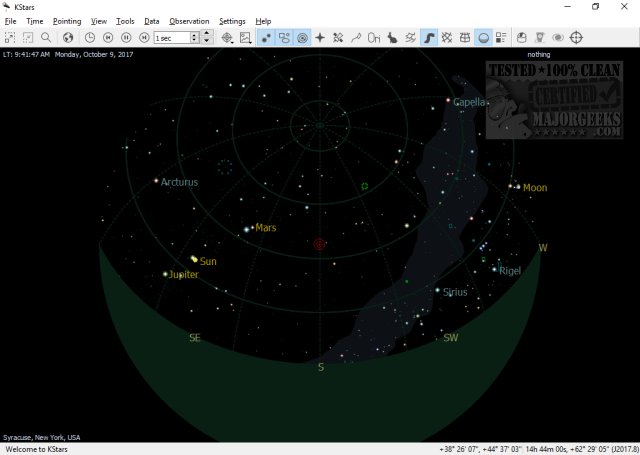
KStars 3.8.1 has been released, offering users a detailed and interactive desktop planetarium experience that accurately simulates the night sky based on their geographical location on Earth. Upon first launch, users are guided through a setup process where they input their location, although smaller towns may not be listed, necessitating the selection of a nearby larger city. For instance, users in Liverpool, NY may need to select Syracuse, NY instead.
After setting the location, users have the option to download various data files to enhance their KStars experience, which includes images of Messier objects and a complete NGC/IC catalog. While there are approximately ten downloadable options ranging from 81MB to over 1.2GB, at least one download is mandatory before proceeding, although it’s possible to bypass additional downloads by simply clicking OK.
The user interface may seem overwhelming at first, with nine file menu drop-downs and about thirty icons, but hovering over the icons reveals their functions. New users may find it easier to learn by experimenting with the software—zooming, panning, and clicking on icons—rather than trying to navigate through the extensive settings menu. Within a few minutes of exploration, users can identify which features they will utilize frequently. A highlight of the software is the Ekos profile wizard, which enables users to capture images and collect scientific data.
While KStars offers a wealth of fun opportunities to explore the solar system, it may initially feel complex and daunting for new users. However, this complexity can be rewarding as users become more familiar with the software. Embracing the learning curve can lead to a fulfilling experience as one dives deeper into the wonders of astronomy.
To extend this summary, KStars 3.8.1 not only provides an impressive array of features but also encourages community engagement through user forums and tutorials. As users become more adept at using KStars, they can participate in citizen science projects, contributing their observations and data to larger astronomical studies. Additionally, upcoming updates may include enhanced compatibility with various telescopes and improved data visualization tools, making the platform even more accessible and enjoyable for both amateur astronomers and seasoned professionals alike. Exploring the cosmos has never been more interactive, and KStars aims to bridge the gap between technology and the awe-inspiring vastness of space
After setting the location, users have the option to download various data files to enhance their KStars experience, which includes images of Messier objects and a complete NGC/IC catalog. While there are approximately ten downloadable options ranging from 81MB to over 1.2GB, at least one download is mandatory before proceeding, although it’s possible to bypass additional downloads by simply clicking OK.
The user interface may seem overwhelming at first, with nine file menu drop-downs and about thirty icons, but hovering over the icons reveals their functions. New users may find it easier to learn by experimenting with the software—zooming, panning, and clicking on icons—rather than trying to navigate through the extensive settings menu. Within a few minutes of exploration, users can identify which features they will utilize frequently. A highlight of the software is the Ekos profile wizard, which enables users to capture images and collect scientific data.
While KStars offers a wealth of fun opportunities to explore the solar system, it may initially feel complex and daunting for new users. However, this complexity can be rewarding as users become more familiar with the software. Embracing the learning curve can lead to a fulfilling experience as one dives deeper into the wonders of astronomy.
To extend this summary, KStars 3.8.1 not only provides an impressive array of features but also encourages community engagement through user forums and tutorials. As users become more adept at using KStars, they can participate in citizen science projects, contributing their observations and data to larger astronomical studies. Additionally, upcoming updates may include enhanced compatibility with various telescopes and improved data visualization tools, making the platform even more accessible and enjoyable for both amateur astronomers and seasoned professionals alike. Exploring the cosmos has never been more interactive, and KStars aims to bridge the gap between technology and the awe-inspiring vastness of space
KStars 3.8.1 released
KStars is a desktop planetarium that provides an accurate graphical simulation of the night sky from Earth's location.