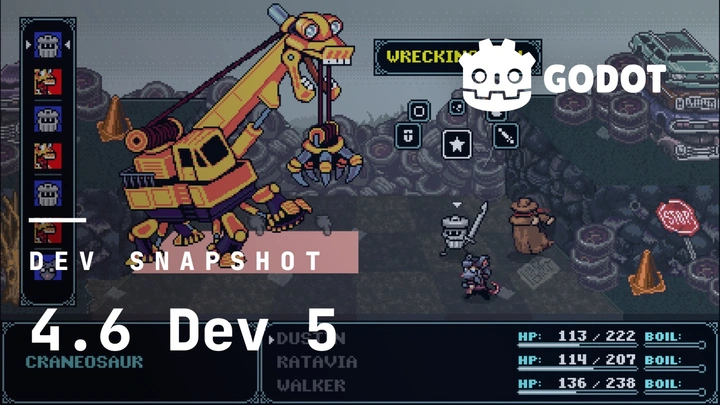
Godot has officially released its fifth developer preview of version 4.6, signaling the approach of a feature freeze set for December 3rd. This version introduces significant updates, including a shift to Direct3D 12 (D3D12) as the default rendering option for Windows, due to persistent stability issues with Vulkan drivers. Developers can still access Vulkan manually if desired, particularly those transitioning from Godot 4.5.
A noteworthy enhancement is the implementation of delta encoding for file patching, which optimizes the update process by only exporting the elements of files that have changed. This feature can significantly reduce the size of PCK files and improve deployment speed, especially for localization purposes. However, delta encoding is off by default due to its additional runtime load, requiring developers to activate it in the export options.
In the realm of mobile development, Godot has made strides in Android support, enabling Gradle builds directly on mobile devices. This development allows game creation within the Godot editor on Android, simplifying the process for developers. A companion application is also in the works to facilitate this build process.
For VR/AR developers, Godot has enhanced its OpenXR support to version 1.1, ensuring compatibility with both newer and older headsets. This upgrade includes a compatibility layer to ease the transition for projects targeting various headset versions.
The 2D renderer has also seen a performance boost, with optimizations in mesh generation that can improve rendering speeds significantly, potentially doubling or even increasing performance by up to seven times under heavy graphics loads.
Additional improvements include features like scene tile rotation within TileMapLayer, enhanced reference targets in BoneConstraint3D, and changes to how AnimationLibrary data is serialized. Overall, the release boasts numerous bug fixes across various subsystems, contributing to the stability of the engine.
As the Godot community continues to thrive, 134 contributors have come together to submit 323 fixes in preparation for the upcoming feature freeze. For a comprehensive overview of the changes made in this release, users can explore the interactive changelog detailing all modifications since the previous version.
In summary, Godot 4.6 Dev 5 represents a crucial step towards finalizing the upcoming version, with a focus on enhancing stability, performance, and usability across multiple platforms, making it an exciting time for developers using the engine
A noteworthy enhancement is the implementation of delta encoding for file patching, which optimizes the update process by only exporting the elements of files that have changed. This feature can significantly reduce the size of PCK files and improve deployment speed, especially for localization purposes. However, delta encoding is off by default due to its additional runtime load, requiring developers to activate it in the export options.
In the realm of mobile development, Godot has made strides in Android support, enabling Gradle builds directly on mobile devices. This development allows game creation within the Godot editor on Android, simplifying the process for developers. A companion application is also in the works to facilitate this build process.
For VR/AR developers, Godot has enhanced its OpenXR support to version 1.1, ensuring compatibility with both newer and older headsets. This upgrade includes a compatibility layer to ease the transition for projects targeting various headset versions.
The 2D renderer has also seen a performance boost, with optimizations in mesh generation that can improve rendering speeds significantly, potentially doubling or even increasing performance by up to seven times under heavy graphics loads.
Additional improvements include features like scene tile rotation within TileMapLayer, enhanced reference targets in BoneConstraint3D, and changes to how AnimationLibrary data is serialized. Overall, the release boasts numerous bug fixes across various subsystems, contributing to the stability of the engine.
As the Godot community continues to thrive, 134 contributors have come together to submit 323 fixes in preparation for the upcoming feature freeze. For a comprehensive overview of the changes made in this release, users can explore the interactive changelog detailing all modifications since the previous version.
In summary, Godot 4.6 Dev 5 represents a crucial step towards finalizing the upcoming version, with a focus on enhancing stability, performance, and usability across multiple platforms, making it an exciting time for developers using the engine
Godot 4.6 Dev 5 released
Godot has released its fifth developer preview of version 4.6, which marks the engine's progression towards feature freeze on December 3rd. Key updates include defaulting to Direct3D 12 (D3D12) for Windows rendering due to stability issues with Vulkan drivers and the introduction of delta encoding for optimized file patching. The release also sees progress in Android development, enabling Gradle builds directly on mobile devices, as well as smoother VR/AR support via OpenXR 1.1 and a performance boost for the 2D renderer. Additionally, numerous bug fixes have been implemented across various areas of the engine to ensure stability before the feature freeze.