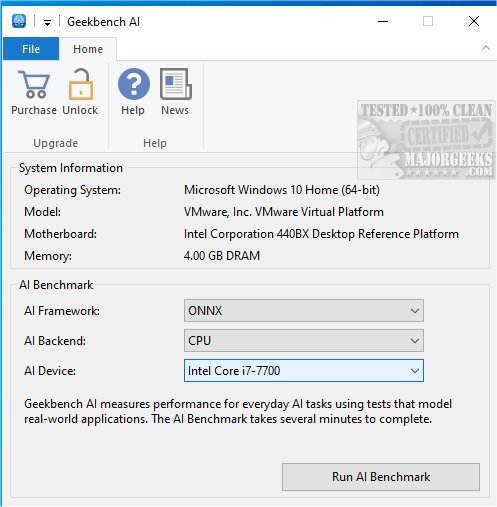
Geekbench AI 1.7.0 has been released as a cutting-edge benchmarking tool designed to evaluate AI workload performance across multiple platforms. This tool specifically measures the efficiency and capabilities of AI systems by employing real-world machine learning tasks, which provides users with valuable insights into AI performance variations among different devices.
One of the key features of Geekbench AI is its ability to assess a device's readiness for AI applications by evaluating its CPU, GPU, and NPU capabilities. It runs ten distinct AI workloads with three types of data, delivering a comprehensive analysis of on-device AI performance. Users can obtain detailed results in just a few minutes, thanks to large datasets that mimic real-world AI scenarios. The benchmarking tool provides scores in Single Precision, Half Precision, and Quantized formats, enabling a nuanced understanding of the device's AI capabilities.
Furthermore, Geekbench AI allows for performance analysis across various hardware components, offering users the flexibility to choose from different AI frameworks, such as Core ML or QNN. This customization feature aids developers in selecting the most effective combination of frameworks and models for specific AI tasks.
The tool also empowers users to accurately gauge the influence of dedicated AI hardware on their devices, facilitating better decision-making for AI-related applications. By incorporating machine learning workloads that reflect real-world tasks, Geekbench AI ensures that devices are equipped to handle both current and future advanced AI applications.
In conclusion, Geekbench AI 1.7.0 is an essential tool for developers and consumers alike, providing them with the means to assess and enhance their devices' AI capabilities. As AI technology continues to evolve, benchmarking tools like Geekbench AI will play a crucial role in helping users stay informed and competitive in this rapidly advancing field. Future updates might include enhanced support for emerging AI frameworks, additional performance metrics, and improved user interface features for an even more streamlined benchmarking experience
One of the key features of Geekbench AI is its ability to assess a device's readiness for AI applications by evaluating its CPU, GPU, and NPU capabilities. It runs ten distinct AI workloads with three types of data, delivering a comprehensive analysis of on-device AI performance. Users can obtain detailed results in just a few minutes, thanks to large datasets that mimic real-world AI scenarios. The benchmarking tool provides scores in Single Precision, Half Precision, and Quantized formats, enabling a nuanced understanding of the device's AI capabilities.
Furthermore, Geekbench AI allows for performance analysis across various hardware components, offering users the flexibility to choose from different AI frameworks, such as Core ML or QNN. This customization feature aids developers in selecting the most effective combination of frameworks and models for specific AI tasks.
The tool also empowers users to accurately gauge the influence of dedicated AI hardware on their devices, facilitating better decision-making for AI-related applications. By incorporating machine learning workloads that reflect real-world tasks, Geekbench AI ensures that devices are equipped to handle both current and future advanced AI applications.
In conclusion, Geekbench AI 1.7.0 is an essential tool for developers and consumers alike, providing them with the means to assess and enhance their devices' AI capabilities. As AI technology continues to evolve, benchmarking tools like Geekbench AI will play a crucial role in helping users stay informed and competitive in this rapidly advancing field. Future updates might include enhanced support for emerging AI frameworks, additional performance metrics, and improved user interface features for an even more streamlined benchmarking experience
Geekbench AI 1.7.0 released
Geekbench AI is a comprehensive cross-platform benchmarking tool designed to assess and evaluate the performance of AI workloads.