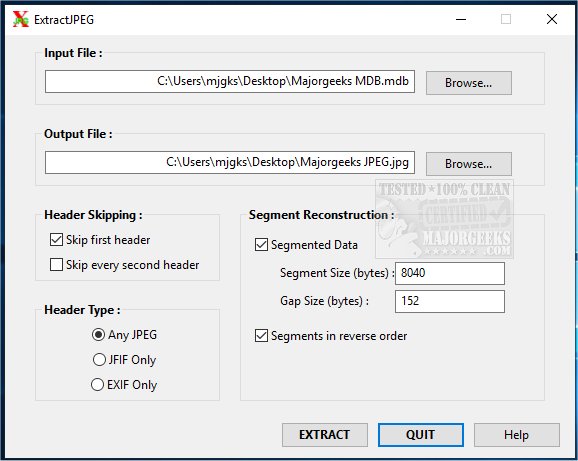
ExtractJPEG version 3.2 has been released, providing users with a powerful tool for extracting JPEG images from various database or document files, even when the storage format is unknown. This software is engineered to identify and extract images by locating properly formatted JPEG file headers and gathering all associated data that follows the header as part of the JPEG image.
The program operates effectively when images are stored in a complete record format, which is common in many database systems. However, in cases where large images are split into multiple records, ExtractJPEG can still function, provided that the segments of the image are stored consecutively in the database. Users can assist the program by specifying a "segment size," representing the total number of bytes in each segment, and a "gap size," which is the number of unwanted bytes at the end of each segment. This allows ExtractJPEG to reconstruct images even if there is extraneous data, such as database record header information, between segments.
Despite its capabilities, ExtractJPEG has limitations. If image segments are not stored consecutively, the software may only retrieve partial or damaged image data. Additionally, while it can extract valid JPEG image data, it does not have the ability to recover the original filenames of the stored images. The output files will carry a user-defined name along with a unique image number before the .jpg extension. It's important to note that ExtractJPEG exclusively targets JPEG format images and will not process any other image types. Furthermore, the program requires that the JPEG images have not been re-compressed in any manner.
In summary, ExtractJPEG 3.2 is a specialized extraction tool for JPEG images, designed to handle various storage conditions, but it is essential for users to understand its limitations regarding non-consecutive records and output naming conventions. As the demand for image retrieval from diverse data sources grows, tools like ExtractJPEG will continue to play a critical role in digital forensics and data recovery. Future versions may expand capabilities to support other image formats or improve handling of fragmented records, enhancing its utility in complex data environments
The program operates effectively when images are stored in a complete record format, which is common in many database systems. However, in cases where large images are split into multiple records, ExtractJPEG can still function, provided that the segments of the image are stored consecutively in the database. Users can assist the program by specifying a "segment size," representing the total number of bytes in each segment, and a "gap size," which is the number of unwanted bytes at the end of each segment. This allows ExtractJPEG to reconstruct images even if there is extraneous data, such as database record header information, between segments.
Despite its capabilities, ExtractJPEG has limitations. If image segments are not stored consecutively, the software may only retrieve partial or damaged image data. Additionally, while it can extract valid JPEG image data, it does not have the ability to recover the original filenames of the stored images. The output files will carry a user-defined name along with a unique image number before the .jpg extension. It's important to note that ExtractJPEG exclusively targets JPEG format images and will not process any other image types. Furthermore, the program requires that the JPEG images have not been re-compressed in any manner.
In summary, ExtractJPEG 3.2 is a specialized extraction tool for JPEG images, designed to handle various storage conditions, but it is essential for users to understand its limitations regarding non-consecutive records and output naming conventions. As the demand for image retrieval from diverse data sources grows, tools like ExtractJPEG will continue to play a critical role in digital forensics and data recovery. Future versions may expand capabilities to support other image formats or improve handling of fragmented records, enhancing its utility in complex data environments
ExtractJPEG 3.2 released
ExtractJPEG allows JPEG image extraction from database or document files even if you do not know how the images are stored.